

CJMD Quarterly Report — Spring 2026
This winter, we explored the rise of political violence in the U.S., coverage of the war in Iran, and efforts by journalists and citizens to obtain public records. This spring, we’re looking forward to a conversation with Seattle’s first AI officer and convening a “future lab” that will work on the next steps for public media.
Read on for highlights from the past few months and stay connected for what’s next.
CJMD Hosts Conversation on Rising Political Violence With New Yorker Writer Benjamin Wallace-Wells
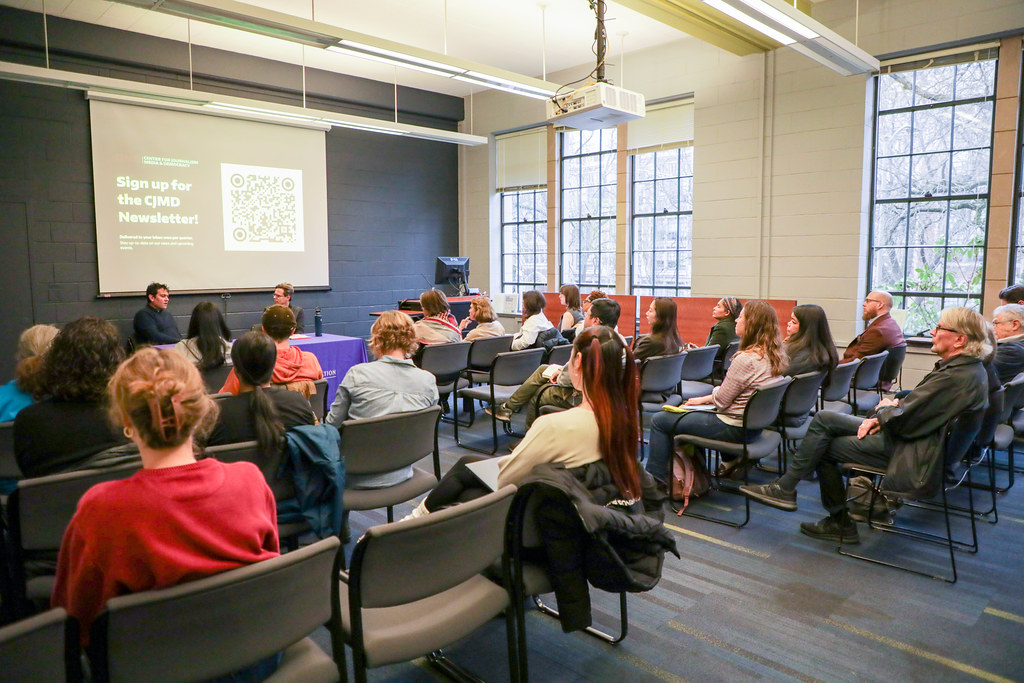
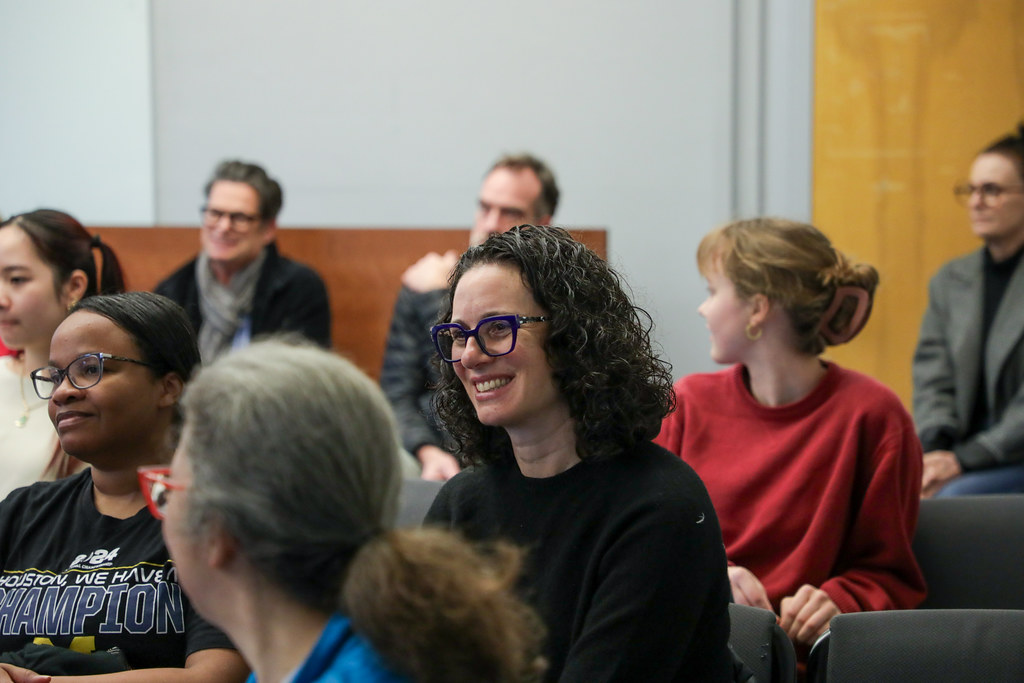
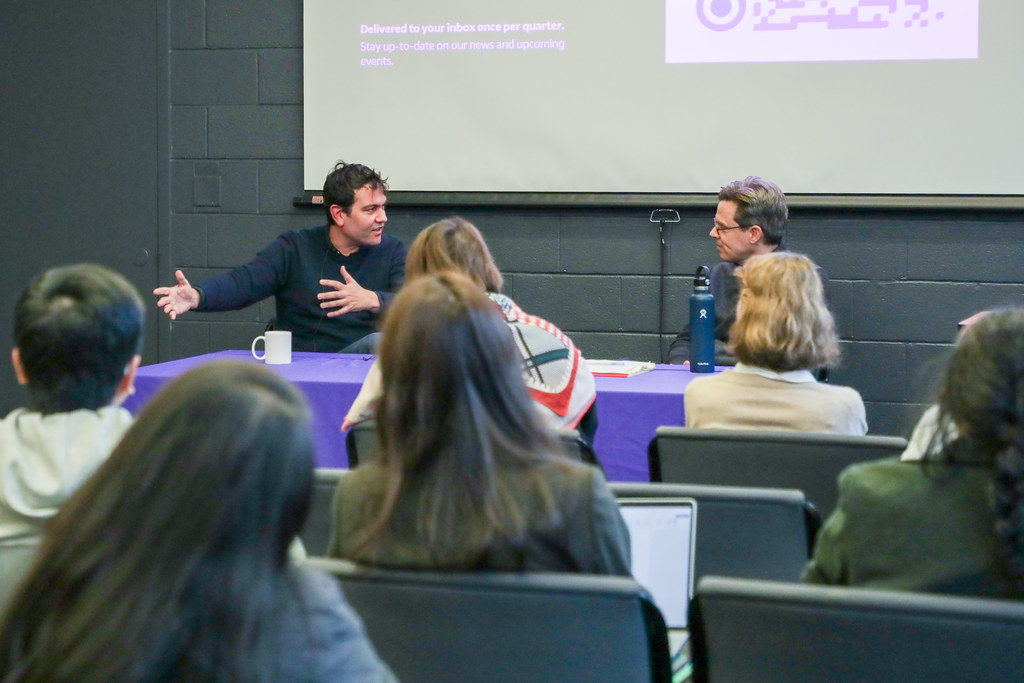
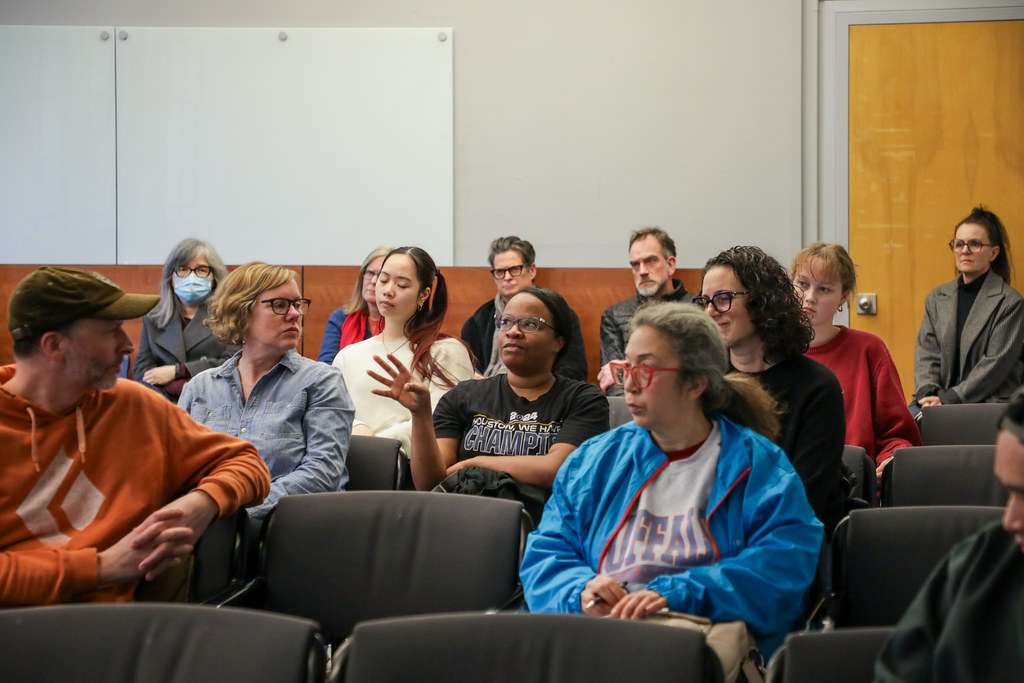
On Jan. 14 at the University of Washington, the Center for Journalism, Media, and Democracy (CJMD) hosted a discussion on political violence in the U.S. with The New Yorker staff writer Benjamin Wallace-Wells. Around 40 to 50 people filled the room, all students, faculty, staff, and community members interested in or studying journalism, communication, political science, and related fields.
Wallace-Wells spoke about his recent article “In the Line of Fire,” published in The New Yorker on Dec. 1, which examines the rise of political violence and threats against elected officials. Wallace-Wells said the idea for the article developed while he was reporting on politics and hearing from individuals working in political offices that threats had become routine. “It was in the air,” he said.
The article centers on Pennsylvania Gov. Josh Shapiro, whom Wallace-Wells said served as the spine of the story. Shapiro’s story is complex, with many sides: he is the democratic governor of Pennsylvania, one of the states with a high number of Jan. 6 defendants, and he has been active in suppressing pro-Palestinian protests on college campuses. On Passover last year, Shapiro and his family were targeted in an attack at their home. The perpetrator, Cody Balmer, set fire to part of the governor’s residence while Shapiro and his family were sleeping inside. The fire damaged a section of the home, but the family was able to evacuate safely.
Although the attacker had no documented affiliation with the pro-Palestine movement, Balmer confessed to the attack in a phone call to a 911 operator after the incident, saying, “Governor Josh Shapiro needs to know that Cody Balmer will not take part in his plans for what he wants to do to the Palestinian people.”
The following day, Shapiro held a press conference outside the residence, standing in front of the burned section of his home. Wallace-Wells used Shapiro’s experience to underscore how political violence operates in America today.
During the conversation at UW, Wallace-Wells described how political violence in the United States is changing in two main ways: scale and type. The scale can be measured by the growing number of threats directed at politicians. But change in type, which Wallace-Wells describes as the more interesting of the two, is less straightforward. Political attacks in the 20th century were often connected to movements, and the perpetrator’s path to radicalization could usually be traced—for example, Timothy McVeigh, who carried out the Oklahoma City bombing in 1995, was motivated by a staunch anti-government stance shaped by events like the 1993 Waco siege and the 1992 Ruby Ridge standoff. By contrast, political violence in the 21st century increasingly involves lone actors, with no co-conspirators or clear ideological journey. Balmer, like other recent attackers, shows no apparent story of radicalization.
Another major focus of the conversation had to do with the mimetic quality of these attacks — they copy the form of earlier incidents rather than coming from a clear ideological path. Motives are often tied to political slogans and sentiments instead of structured belief systems, as seen in the bullet casings from the Sept. 2025 ICE shooting in Dallas, which had “ANTI-ICE” written on them.
On the topic of motives, Wallace-Wells questioned the idea that political violence today is primarily driven by disenfranchised young men. While some extremist groups fit that narrative, many perpetrators of recent political violence do not. There is little consistency in this respect across cases, but one pattern discussed by Wallace-Wells and an audience member revealed how political violence today is similar to school shootings in that they are becoming a trend. In fact, Wallace-Wells named stories like this article in New York Times, “Like School Shootings, Political Violence Is Becoming Almost Routine”, as another influence for his article.
Wallace-Wells also brought up the increasingly blurry boundary between free speech and actual threats. For example, Wallace-Wells cited a common pattern identified by law enforcement in which a constituent repeatedly calls their representative about dissatisfaction with care at the Department of Veterans Affairs, only for the complaint to escalate into a direct threat. In more severe cases, threats implied surveillance, such as letters sent to a lawmaker’s home that included photos of their children, signaling proximity rather than stating violence outright.
Wallace-Wells noted in both the article and to the audience how political violence is already affecting public life. Some local officials have chosen not to run for office again. Others no longer advertise public events online, limiting public access and democratic participation. Similarly, political violence is shaping who enters politics. It was noted that the people who are more cautious are leaving public service, while others who are brave and less deterred by threats remain.
Wallace-Wells addressed responses to political violence, including calls to disengage from politics altogether, such as what journalist Derek Thompson has described as “touch-grass populism.” Wallace-Wells argued that this instinct—to look away from politics in hopes that threats and violence will subside—implicitly admits that liberalism does not have a ready solution to the problem. He then warned about the opposite risk: illiberal responses that move quickly toward blame and punishment. Politics often fails to distinguish between lone-actor violence and collective responsibility, creating fear that responses to political threats could lead to broader punishment, expanded state power and, ultimately, state violence.
The event concluded with a discussion of how political violence is affecting civic life. Wallace-Wells pushed back against the idea of “touch-grass populism,” the notion that we can avoid these problems by turning away from politics and ignoring what’s happening. Instead, he argued, these conversations need to happen so we can face the realities of political violence rather than hope it goes away on its own.
Miranda Spivack on local government secrecy, public records, and accountability
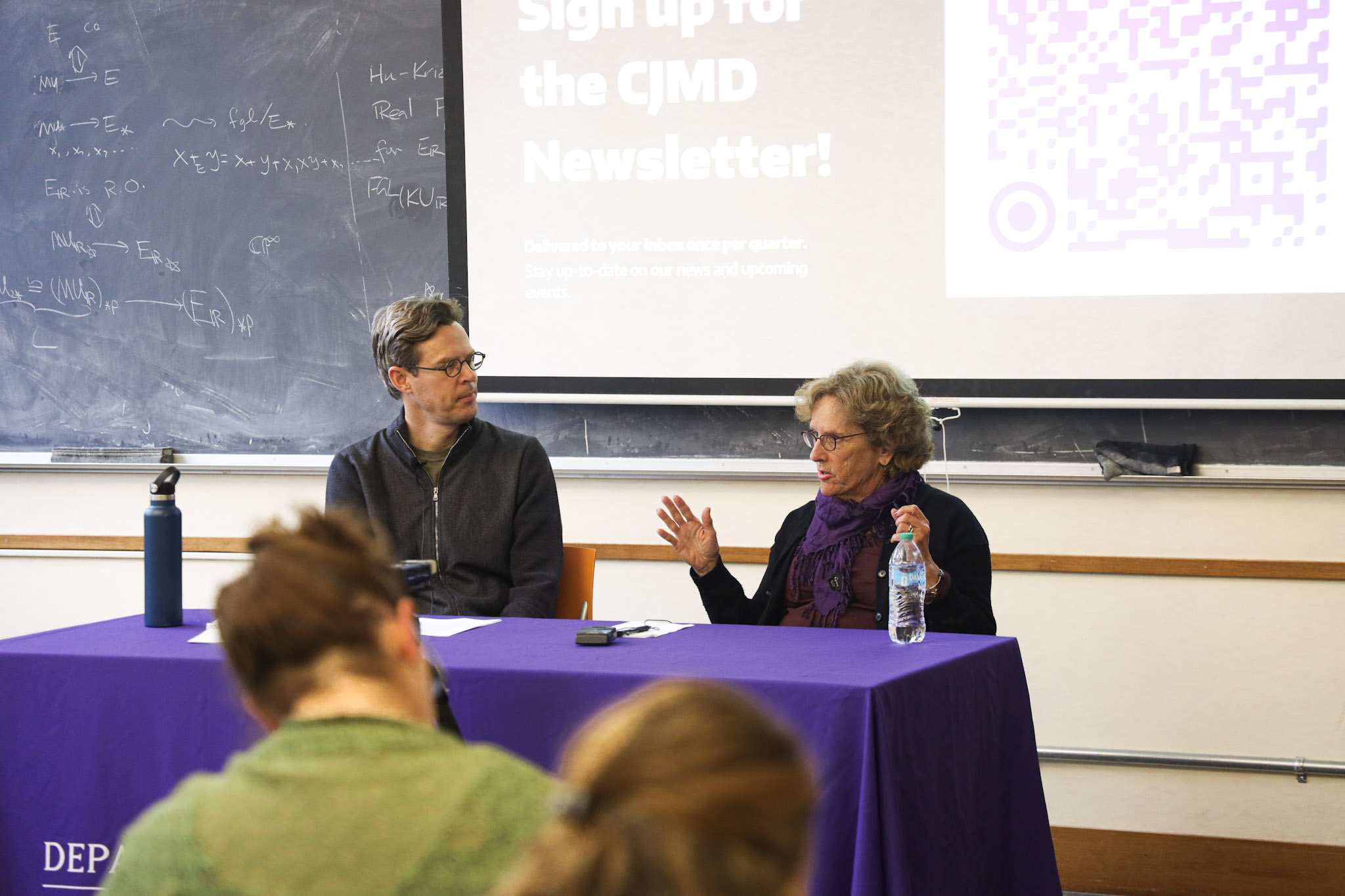
Veteran journalist discusses how gaps in public records access shape transparency, accountability, and civic life in local communities.
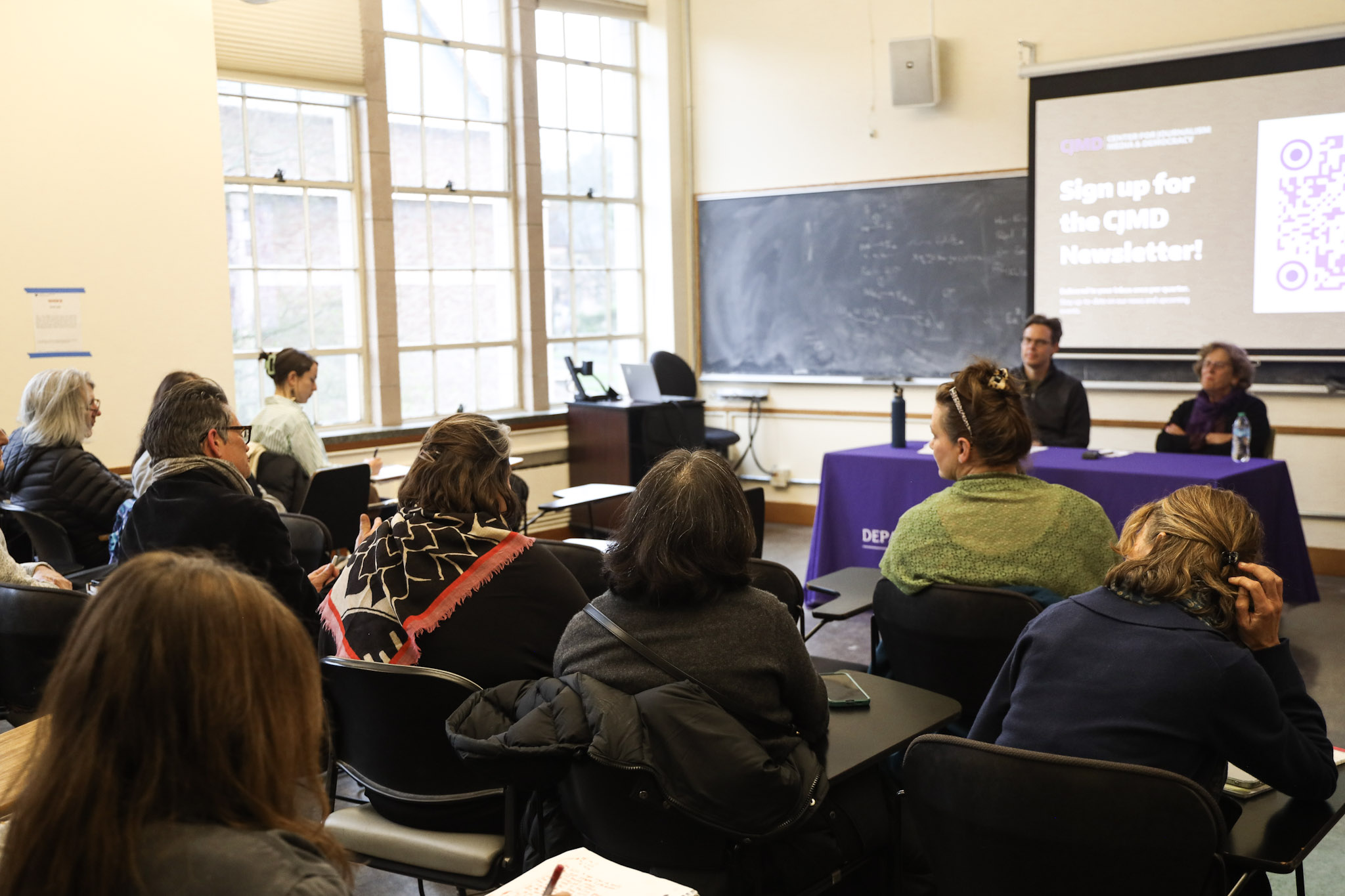
At a Mar. 12 CJMD event, award-winning journalist and editor Miranda Spivack discussed government secrecy at the local level and the limits of public records systems.
The conversation, moderated by CJMD co-director Matt Powers, was based on Spivack’s new book Backroom Deals in Our Backyards: How Government Secrecy Harms Our Communities and the Local Heroes Fighting Back, centering on how public records systems operate in practice and who is able to use them effectively.
“Billions of dollars in public money are being spent by local governments, and we don’t know what’s going on,”she said.
Access exists, but not equally
Spivack described how her reporting on local government while employed at the Washington Post shaped her focus on transparency. Even with institutional backing, she struggled to obtain basic records, which led her to consider how the system works for people without that support.
“I’m a journalist, I know how to do this,” she said. “What if you are so-and-so down the street who just wants to know why your pothole isn’t being fixed?”
Public records laws exist in all states, but access depends on time, persistence, and often legal knowledge. Requests can take months, be denied on technical grounds, or produce incomplete data.
During the event, Spivack pointed to cases where information existed but was not accessible in a usable way. In one example, accident data tied to a serious cycling injury had to be reconstructed from individual police reports because agencies would not release the full dataset. The analysis ultimately showed patterns that supported claims of negligence, but only after significant effort.
That outcome was possible because resources were available, but for most people, that path is not.
“Information blockades”
Spivack described the structure of the system as an “information blockade,” emphasizing that the issue is not only denial but obstruction through process.
“I have this vision that they’re erecting these walls,” she said. “We, the public, are on the other side, and you just can’t get through.”
Records may be technically public, but they are often fragmented, delayed, or withheld through exemptions. Requests can require multiple filings, follow-ups, and appeals. In some cases, agencies release partial information that requires further analysis or additional requests to interpret.
This affects how communities respond to problems. Without access to complete records, it is difficult to determine whether risks were known, whether decisions were justified, or whether public funds were used appropriately.
Spivack said the pattern is consistent across different states and agencies.
“It is bad everywhere,” she said.
Trade secrets and contractor control
A significant portion of the discussion focused on the role of private contractors in limiting transparency. As more public functions are outsourced, private entities increasingly control information tied to government operations.
Spivack described how trade secret claims are used to block disclosure of records related to public contracts. These claims are often accepted by agencies without detailed review.
“Governments are ill-equipped,” she said. “Some person processing fifty FOIA requests doesn’t know what a trade secret is. The companies are really running the show on that.”
This dynamic allows companies to withhold information about wages, hiring practices, safety compliance, or contract performance, even when public funds are involved. The result is reduced visibility into how government contracts are executed.
“I think what you’re having more and more is what I would call corporate capture of state and local governments,” she said. “They’re in the driver’s seat way more than they used to be.”
Who uses public records
Spivack also addressed how public records systems are used. While the laws are designed for general access, the majority of requests come from corporations.
“The vast users of public records requests are corporations,” she said.
Businesses use these systems to gather information about competitors, contracts, and regulatory decisions. These requests can be large in volume and require significant administrative effort to process.
“They are flooding the zone,” she said. “The taxpayers — we’re underwriting it. That’s us.”
The cost of responding to those requests is borne by the public. At the same time, individuals and community groups rely on the same system to obtain information about local conditions and government actions. The structure, which the CJMD is currently researching in its Journalists, Transparency, and Democratic Governance project, does not distinguish between commercial and public-interest use, but the capacity to navigate the system differs.
News deserts and “accidental activists”
Spivack connected these issues to the decline of local journalism. In many of the cases she examined, reporters were not the primary drivers of investigation.
“I think it’s a reflection of the vast news deserts around the country,” she said.
In the absence of sustained reporting, individuals often take on the role of investigator. Spivack refers to them as “accidental activists” — people responding to specific problems in their communities who then begin navigating public records systems.
“They get rebuffed. They get really mad. They get really angry,” she said. “They are very, very tenacious.”
Over time, they develop expertise, build networks, and continue pursuing information. These efforts can last for years and often depend on sustained personal commitment rather than institutional support.
Technology and limits of reform
Audience questions expanded the discussion to include artificial intelligence and technological tools for processing records. Spivack said these tools may assist with searching and organizing information but do not resolve structural issues.
“You could use [AI] as a search tool,” she said. “But you’re still going to have to have a human being double-check it.”
She noted that errors are common and that agencies may not prioritize improving access.
“You can never underestimate incompetence,” she said. “But some of it is deliberate obfuscation.”
She also emphasized that democratic oversight and regulation often lags behind technological change.
“Technology is constantly outpacing the law,” she said.
Practical access and reporting
Spivack closed with practical advice to student journalists focused on how people interact with public records systems. Access is shaped not only by law but by administrative practices and relationships.
“Get to know the people who actually possess the records, and do it in person,” she said.
Understanding how records are stored, what exists, and who manages access can affect the outcome of a request. In many cases, informal knowledge of systems and personnel is as important as formal legal rights.
Why it matters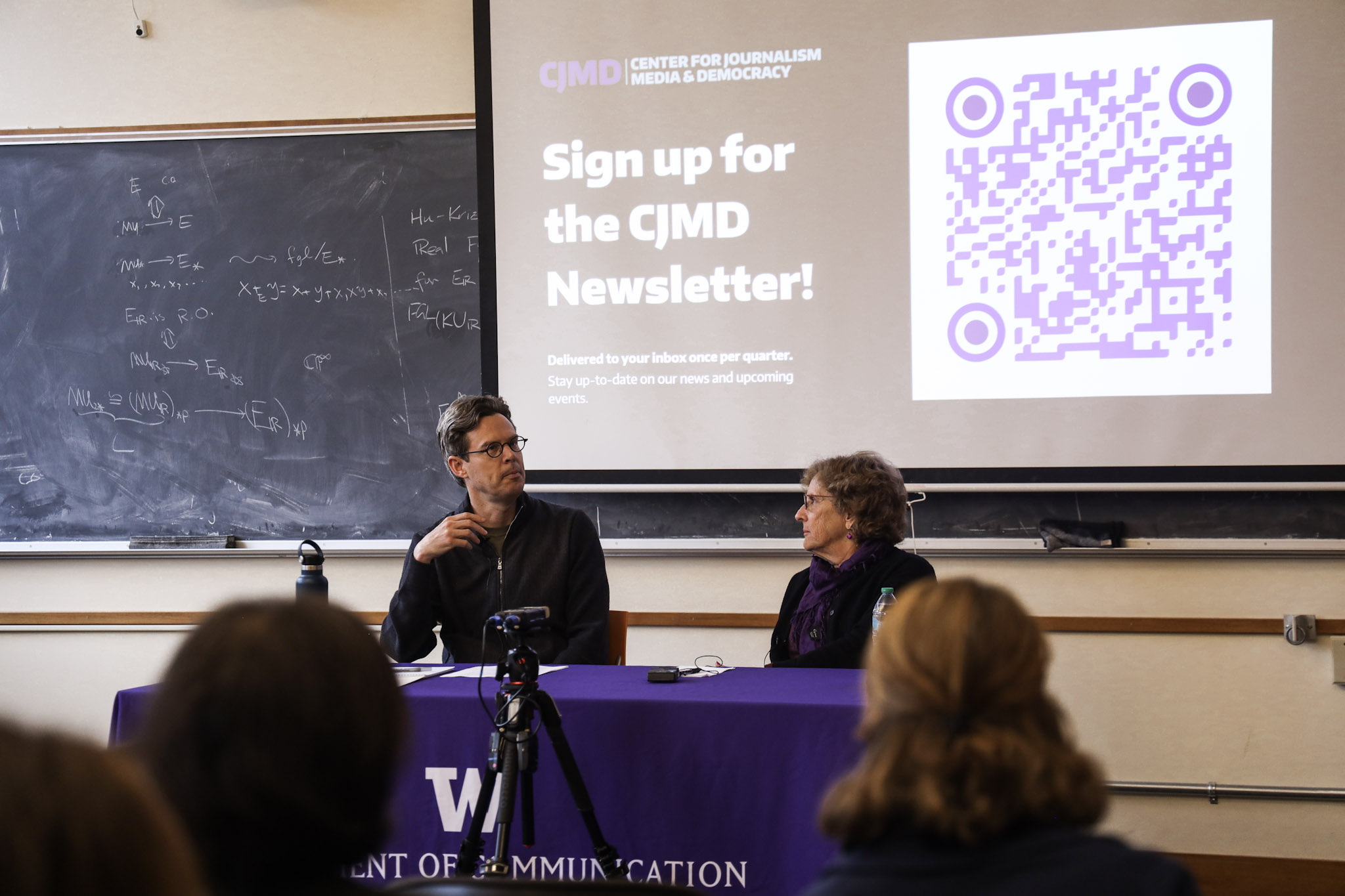
The discussion highlighted the gap between the idea of transparency and its implementation. Public records laws establish a right to access, but that right is mediated by resources, institutional capacity, and procedural barriers.
At the local level, these limitations affect how communities understand and respond to government actions. Access to records shapes whether risks can be identified, decisions evaluated, and accountability established. While records may be public, access is not equitable.
CJMD and the Solidarity Journalism Initiative Host Panel on Reporting and Solidarity in Iran
From misrepresentation to meaningful context, Iranian and Iranian-American journalists reflect on how solidarity can reshape reporting on conflict and crisis.
Journalism has long been guided by truth, accuracy, and public accountability. Yet moments of international crisis often reveal how difficult these ideals can be to uphold.
A recent panel discussion on solidarity, journalism, and Iran explored these tensions, asking what responsibility journalists have when covering conflict, how narratives about Iran have been shaped over time, and whether solidarity can exist within a profession that still holds objectivity as one of its central principles.
The conversation, hosted by the CJMD and University of Texas Austin’s Solidarity Journalism Initiative’s Dangerous Solidarity Working Group, was moderated by media studies researcher Sara Shaban, a fellow at the CJMD, affiliate instructor at the University of Washington, and author of Iranian Feminism and Transnational Ethics in Media Discourse. The panel featured two Iranian journalists and scholars: Neda Toloui-Semnani, an Emmy Award–winning journalist, author, and assistant teaching professor of journalism at Penn State University, and Kourosh Ziabari, a journalist and media studies researcher who contributes to Foreign Policy and New Lines Magazine. Together, they reflected on journalism’s role in shaping public understanding of Iran and the broader Middle East, and on how journalists might better center human experience in their reporting.
Shaban opened the conversation by acknowledging the conflicting narratives that often surround Iran in public discourse. Even within one city, she noted, people can witness dramatically different expressions of solidarity, with some demonstrations supporting international intervention and others protesting against it.
These contradictions reveal how complex the political and emotional landscape surrounding Iran has become. Toloui-Semnani responded by reflecting on her own evolution as a journalist — early in her career covering Washington politics, she began to feel uneasy about the way journalism often framed political power.
“I realized over time… that I was sort of participating in building a wall between the sort of the levers of power within this country…and the people who should feel empowered to be part of it,” she said. “The type of journalism I try to practice now…is meant to position the people who are sort of at the heart of all of these conflicting policies that we see.”
For Toloui-Semnani, solidarity journalism is not necessarily a separate genre of reporting but rather a commitment to telling stories in which people are not treated as bystanders to policy but as central figures within it.
Throughout the discussion, both panelists returned repeatedly to the importance of context in reporting on Iran. Much of the confusion people feel about Iran stems from the absence of historical and social context in news coverage.
“Context around Iran… is deeply lacking,” she said. Journalists often fail to show the everyday realities and external factors that shape people’s lives. One such example is the reporting of Iran’s water crisis. Toloui-Semnani says that understanding public frustration requires looking beyond politics alone.
“If you want to understand, for example, some Iranians’ anger, you have to understand there’s a water crisis,” she said. Ziabari echoed this concern, and said that decades of media narratives have contributed to misunderstanding and misrepresentation of the country.
“Had it not been for… a pattern of misrepresentation of Iran and Iranians in the global mainstream media, especially U.S. corporate media, maybe the direction of relations would have been different,” Ziabari said.
A comparison of coverage of Iran’s water crisis across American- and Iranian-based news organizations highlights the different storytelling approaches used to explain the issue. Iran International, in their Voices from Iran section, published an article in July 2025 titled “‘A big prison with no water or power’: fed up Iranians rue outages,” in which community members of cities such as Karaj are quoted. A New York Times article from March 2026 titled “War Brings New Water Crises to an Already-Parched Iran” only quotes experts who work for American universities.
While both articles attribute the water crisis to the same causes — “chronic mismanagement, flawed policy, and decades of unsustainable water use in agriculture and industry,” as Iran International puts it — only one includes the voices of those enduring the plight.
According to Ziabari, journalists must be willing to recognize their role in shaping the narratives that influence public opinion and policy decisions.
“[We] as journalists have been part of the problem,” he said. “Had it not been for our role as a part of the narrative and those who are cultivating this public discourse around global fault lines, many of these crises could have been prevented.”
The panel also explored the historical relationship between the United States and Iran, particularly the 1953 coup that removed Prime Minister Mohammad Mossadegh. Toloui-Semnani described the event as a turning point that continues to shape relations between the two countries.
The coup, she said, was “Great Britain’s idea… and it was carried out by the U.S.” through the CIA, which she described as “its first real attempt at asserting their influence abroad.”
Understanding this history is essential for understanding the present moment.
“Iran wasn’t just a passing part of American history,” she said. “It was integral to asserting [the United States’] power across the world.”
Ziabari expanded the discussion by highlighting Iran’s long history of civil resistance, from the 1999 student protests to the 2009 Green Movement and the 2022 Woman, Life, Freedom protests. These movements demonstrate that Iranian civil society has repeatedly challenged both domestic repression and foreign intervention.
“There’s no valid argument…that the Iranian people didn’t do enough,” he said. “Iran is a nation in which the political discourse has always been defined by dissent.”
Another key theme was the role of objectivity in journalism. Toloui-Semnani acknowledged that the concept historically served a purpose but argued that it can sometimes obscure deeper inequalities in power and experience.
“If being objective is going in and asking a bunch of questions…then one of my colleagues calls it shut up and listen journalism,” she said, meaning that listening carefully to communities should be a starting point for responsible reporting.
Ziabari approached the issue by emphasizing accountability. Objectivity, he said, is not inherently flawed, but it must include a willingness to challenge misinformation and dehumanizing rhetoric.
“Objectivity per se isn’t…something bad or something that is outdated,” he said. “But it also depends on how we define objectivity.”
For Ziabari, journalists must ensure that their work does not unintentionally reinforce narratives that strip people of their humanity. “We as journalists need to be the voice of our principles,” he said. All reporters should challenge false claims and defend the dignity of those whose stories they tell.
While the conversation focused on the current crisis, the panelists emphasized that journalists should not define Iran solely through conflict or crisis. Ziabari urged journalists to tell broader stories about culture, creativity, and everyday life.
“The food that the people of Iran produce and consume, the art that they produce…these are still missing from our perspectives and narrative,” he said. Expanding coverage to include these dimensions would create a more complete and human understanding of the country.
Toloui-Semnani implored journalists to ask difficult questions and confront contradictions in political discourse. “I’m not an advocacy journalist,” she said. “But I advocate against silence.”
For both speakers, solidarity in journalism ultimately means recognizing the humanity at the center of every story and refusing to allow complex societies to be reduced to simplified narratives.
Upcoming Events: Mike Annany, Jisoo Kim, Austin Jenkins
Mike Ananny | April 22 | 3:30 PM PST
Join us for “Making Generative AI into a Public Problem,” a talk by USC Associate Professor Mike Ananny.
He will explore how generative AI is often framed as an abstract concept rather than a system shaped by human decisions, institutional priorities, and power. The conversation will examine what it means to treat AI as a public issue — one that requires accountability, transparency, and democratic oversight — and how journalists and the public can better understand its real-world impacts.
RSVP today!
Jisoo Kim | May 13 | 3:30 PM PST
CJMD Fellow Jisoo Kim will present: “Why Everything Feels Political Now: How Media Turn Health and Science Into Public Battlegrounds.”
Many Americans now struggle to engage with anything seen as “political,” as debates over health and science increasingly become politicized. In this talk, Jisoo Kim introduces a clear framework for understanding politicization and shares research on how media shape public views, deepen divisions, and influence communication—drawing on cases such as COVID-19 vaccines and climate change, and exploring what these patterns mean for everyday relationships and the health of our democracy.
RSVP here!
Lisa Qian and Austin Jenkins | May 27 | 6:00 PM PST
Join us for a conversation between Lisa Qian, the city of Seattle’s first AI officer, and CJMD fellow Austin Jenkins.
Lisa will discuss Seattle’s approach to responsible and innovative use of AI across city operations and public services, issues that she has addressed since her appointment as City AI Officer, and answer questions from the audience.
RSVP here!
Meagan Doll Reflects on Her Time at the CJMD Ahead of Move to CU Boulder
From UW graduate student to CU Boulder faculty member, Doll shares how her research, mentorship, and the CJMD community shaped her career trajectory.
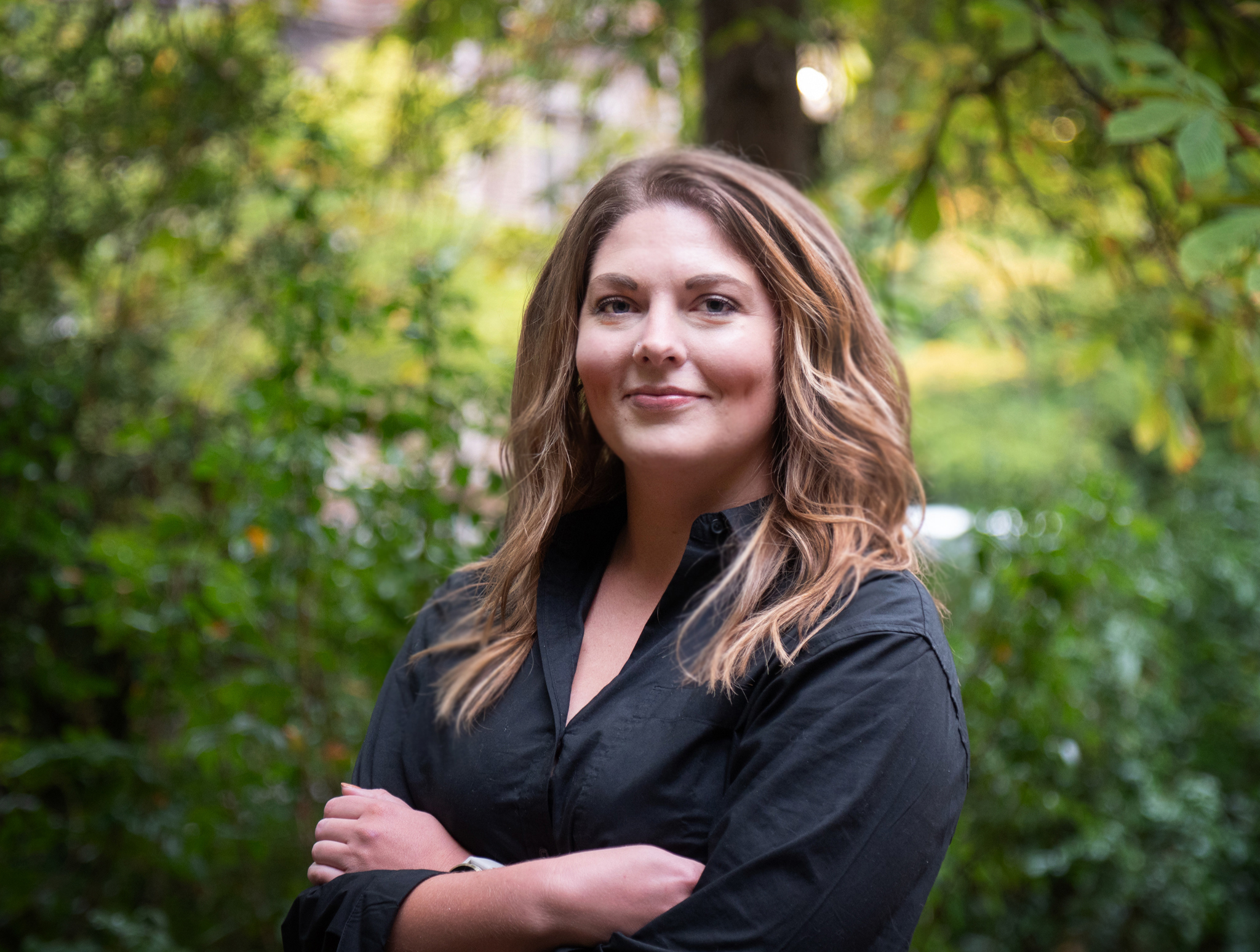
From UW graduate student to CU Boulder faculty member, Doll shares how her research, mentorship, and the CJMD community shaped her career trajectory.
After seven years of research, collaboration, and mentorship at the University of Washington (UW), Meagan Doll is moving on from the CJMD, where she conducted much of her work as a master’s student, Ph.D. student, and postdoctoral fellow. This fall, Doll will begin a new role as an assistant professor of journalism at the University of Colorado Boulder, a move she describes as both personally and professionally meaningful.
“It sort of feels like a homecoming,” Doll said. She was born in Colorado Springs, and much of her family still lives in the area. Academically, she said CU Boulder had been a serious contender when she was applying to graduate school, before she ultimately chose UW.
Doll grew up in Wisconsin, about 40 miles north of Madison, and completed her undergraduate degree at the University of Wisconsin-Madison, where she earned a B.A. in journalism. While journalism was her primary focus, she was also drawn to the university’s interdisciplinary African studies program — one of the best in the country.
During her undergraduate years, she minored in African studies, completed a field study in Rwanda, and later reported from Uganda in 2015 as she finished her degree. Doll enjoyed her work but said that freelance foreign correspondence proved unsustainable for her.

Doll conducting fieldwork in 2023, standing outside a taxi park in Kampala, capital of Uganda.
Doll conducting fieldwork in 2023, standing outside a taxi park in Kampala, capital of Uganda.
“All journalism is difficult work, and foreign correspondence in freelancing was even harder,” Doll said, adding that after one summer she decided it was time to regroup. “I’m too type A, I guess, to be doing that.”
She returned to the University of Wisconsin and worked for the African Studies Program, eventually becoming an assistant director. Working closely with students, graduate students, and faculty drew her toward higher education administration. “I really liked working on a university campus,” she said. “It got to the point where I was like, ‘I could do admin forever.’ I really liked it, but to move up the admin ladder, at some point you do need a Ph.D.”
Doll chose UW for graduate school and ultimately earned both her M.A. and Ph.D in Communication. UW stood out to her because of the enthusiasm of the faculty and the opportunity to work closely with UW professor, researcher, and co-director of the Center for Journalism, Media, and Democracy (CJMD), Matthew Powers, whom she sought out early on. “He was the person that I wanted to work with, especially for my master’s thesis,” she said.
Through that connection, Doll became involved with the CJMD almost immediately. She described her introduction as being “kind of grandfathered into it,” beginning with weekly research meetings co-led by Powers and CJMD co-director, Adrienne Russell.
Those meetings were central to her professional development. “Providing feedback, receiving feedback, and integrating feedback from both graduate students and faculty was huge,” Doll said.
Much of Doll’s earlier scholarship focused on international contexts. Her master’s thesis, completed in 2021, examined peace journalism — journalism that reveals the structural and cultural roots of violence and their impact on people in a conflict arena — in East Africa. Her dissertation, completed in 2024, focused on audience trust in journalism in Uganda. That project drew on five weeks of fieldwork and a mixed-methods approach combining interviews and survey data.
One of the key insights from her dissertation, Doll said, was that trust in journalism cannot be separated from broader political conditions, especially in non-democratic environments.
“Evaluations of news and journalism can’t be understood outside of those political pressures,” she said. In Uganda, she found that audiences often held relatively positive views of journalism compared to other institutions, even while recognizing its limitations under restrictive press conditions.
Doll conducting fieldwork in 2023, standing outside a taxi park in Kampala, capital of Uganda.
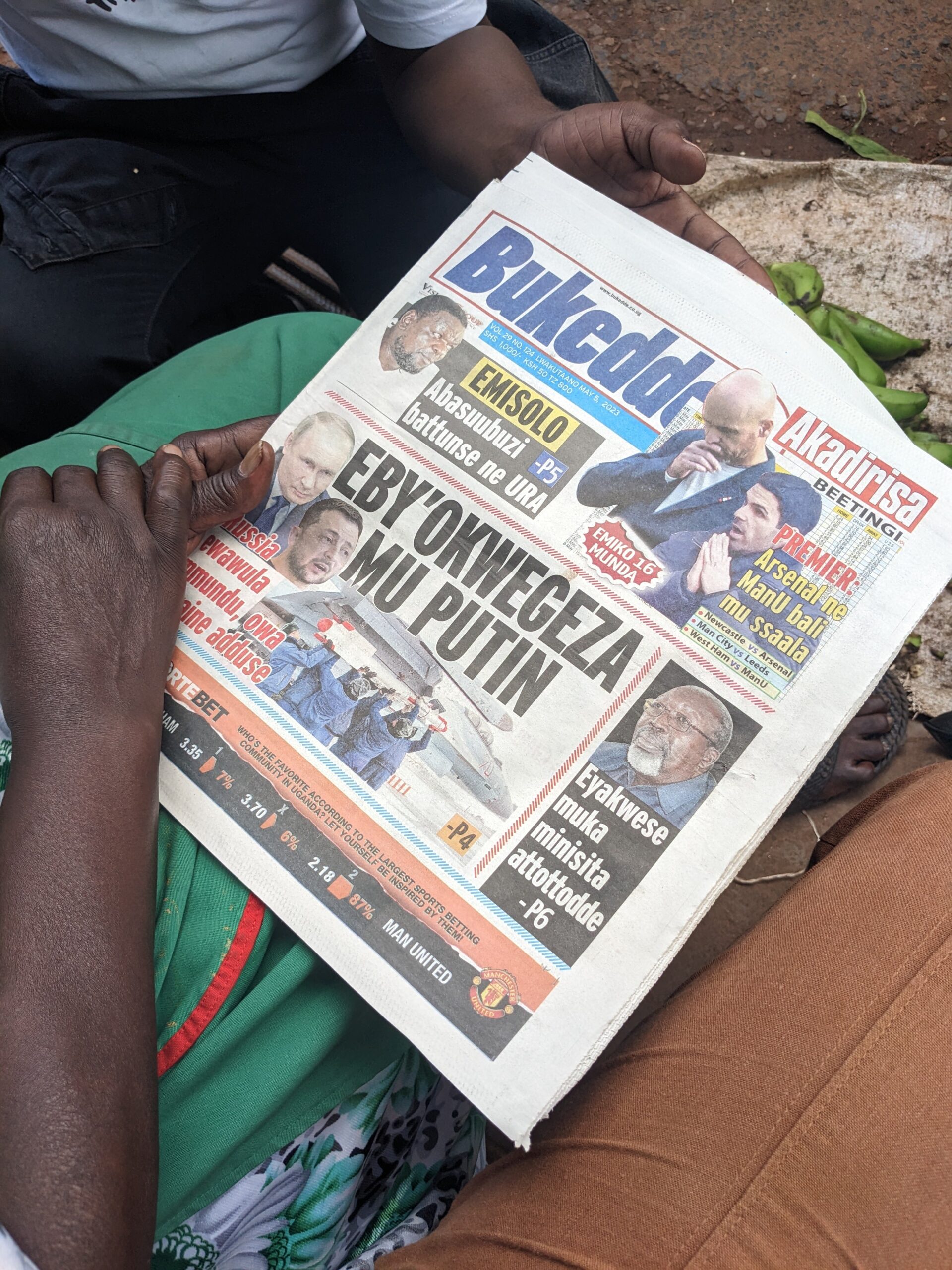
Photo of the front page of Bukedde, taken during an interview Doll conducted with a Kampala market vendor.
While obviously gratified by her dissertation, Doll described her first-ever publication — a meta-analysis of peace journalism content co-authored with Patricia Moy — as the crown jewel of her scholarship. The project began during her first year as a master’s student and ultimately became her master’s thesis. Doll said she is still proud of the work not only because she completed it so early on in her academic career, but because of its impact. The article has been cited extensively and continues to serve as a resource for scholars, helping shape the field’s collective understanding of peace journalism.
The CJMD was central to shaping Doll’s research trajectory. “Any success that’s come from my research since then is inherently touched by their ideas,” she said, referring to the feedback and collaboration she received through the center. She added that the experience helped her learn how to work on team-based, collaborative research projects, which she now considers essential to her career.
One of the most formative parts of her time at the CJMD was the opportunity to collaborate on long-term research projects. Alongside other students and faculty — particularly Powers and Moy, associate vice provost for academic and student affairs and senior fellow at the CJMD — Doll worked on a multi-year study of legislative coverage at the Washington State House. The project began with a large content analysis of coverage from the 2023 legislative session and expanded to include interviews with statehouse journalists, legislative staffers, and elected officials in Olympia. Take a look at her scholarly publications here:
- Missing a Beat? Exploring U.S. State Legislative Coverage Beyond the Politics Desk
- New life for statehouse reporting? The view from one American state
- Explaining the Feminization of Statehouse Reporting in One American State: A Field Analysis
Although U.S. state politics was not originally her main research focus, Doll said the project opened new intellectual and professional doors. “State politics is really important right now,” she said, noting that it remains underexplored in journalism research.
After completing her Ph.D. in 2024, Doll began a postdoctoral fellowship at the CJMD in June of that same year. Just one month later in July, she also became a postdoctoral research associate in the Hubbard School of Journalism and Mass Communication at the University of Minnesota. These dual postdoctoral roles have allowed her to focus heavily on research and begin adapting her dissertation into a book project. “The space to really work on that has been incredibly helpful,” Doll said.
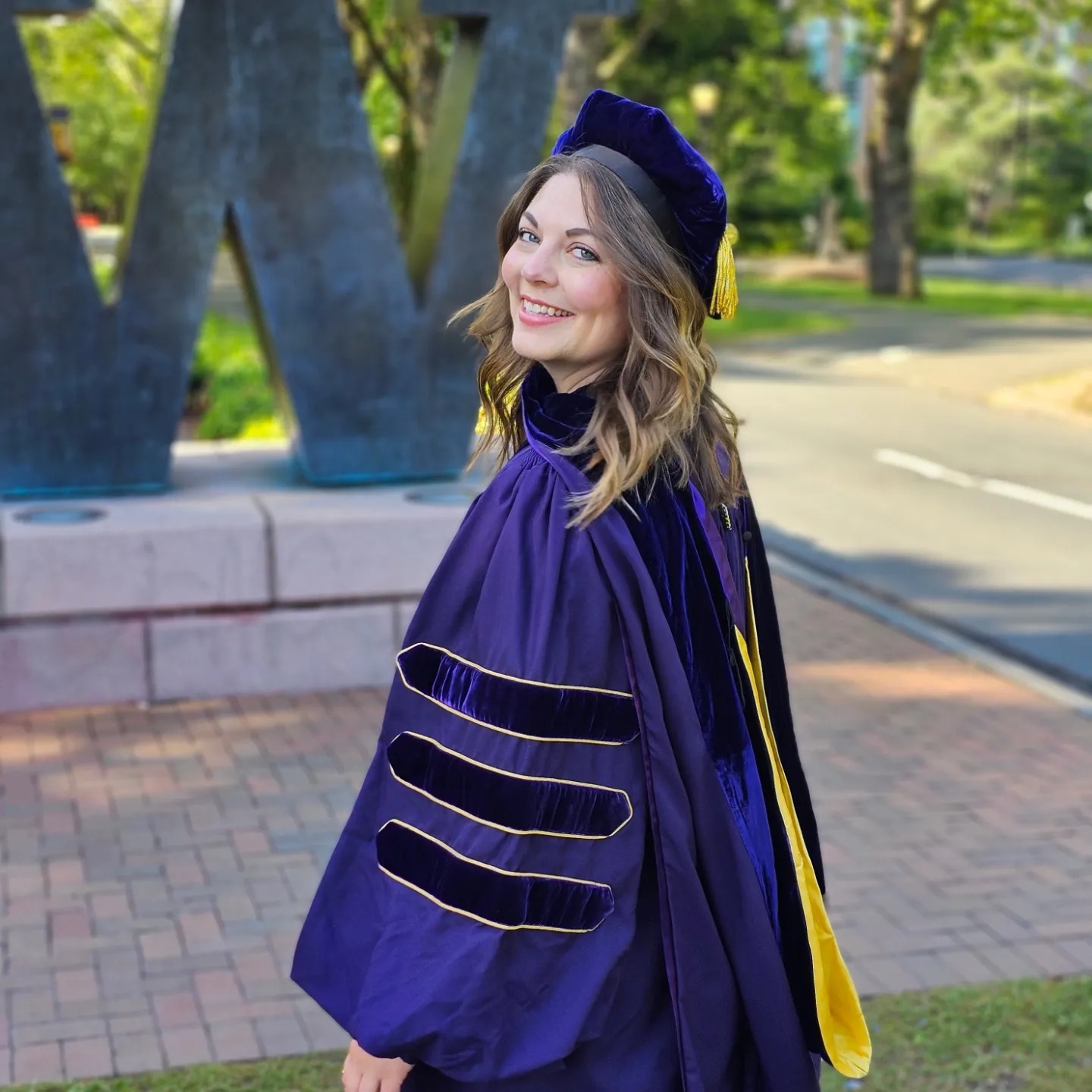
Doll in graduation regalia during 2024 UW commencement week.
Doll in graduation regalia during 2024 UW commencement week.
As she prepares to leave UW and the CJMD and begin her new role in Colorado, Doll is excited to begin teaching students and to settle into a more permanent academic home. “It’ll be nice to have more interpersonal contact with students,” she said. “The gratification is more immediate than research, which can take years.”
When asked for advice for graduate students and those thinking about that path, Doll had this to say:
“Graduate school is hard. And there are so many times where you’ll want to turn inward and sometimes where you’ll have to, right? Like to focus on a specific paper or to meet a conference deadline or something. That’s normal and important at times.
“But I think pushing yourself to take an extra credit or to get involved in these research reading groups, they definitely take up a little bit of extra time. It’s extra pressure to read an extra article that week and give feedback to a colleague. But it’s really important — I think they mimic the real academic world and job landscape, even more in some ways than your coursework.
“That’s the pitch. You’re gonna feel like you don’t want to get involved in these extra responsibilities…extra research opportunities at times. But I think not only for being prepared for the job market, but also for keeping your interest and passion for research alive, it’s necessary to stay plugged into those spaces.
“’Cause graduate school is such an insular experience and can feel, at times, lonely. You spend so much time in your own head. Doing these collaborative group projects and going to the reading group, and going into campus even when you don’t want to, all of that is hard, but I think it makes your profession doable.”
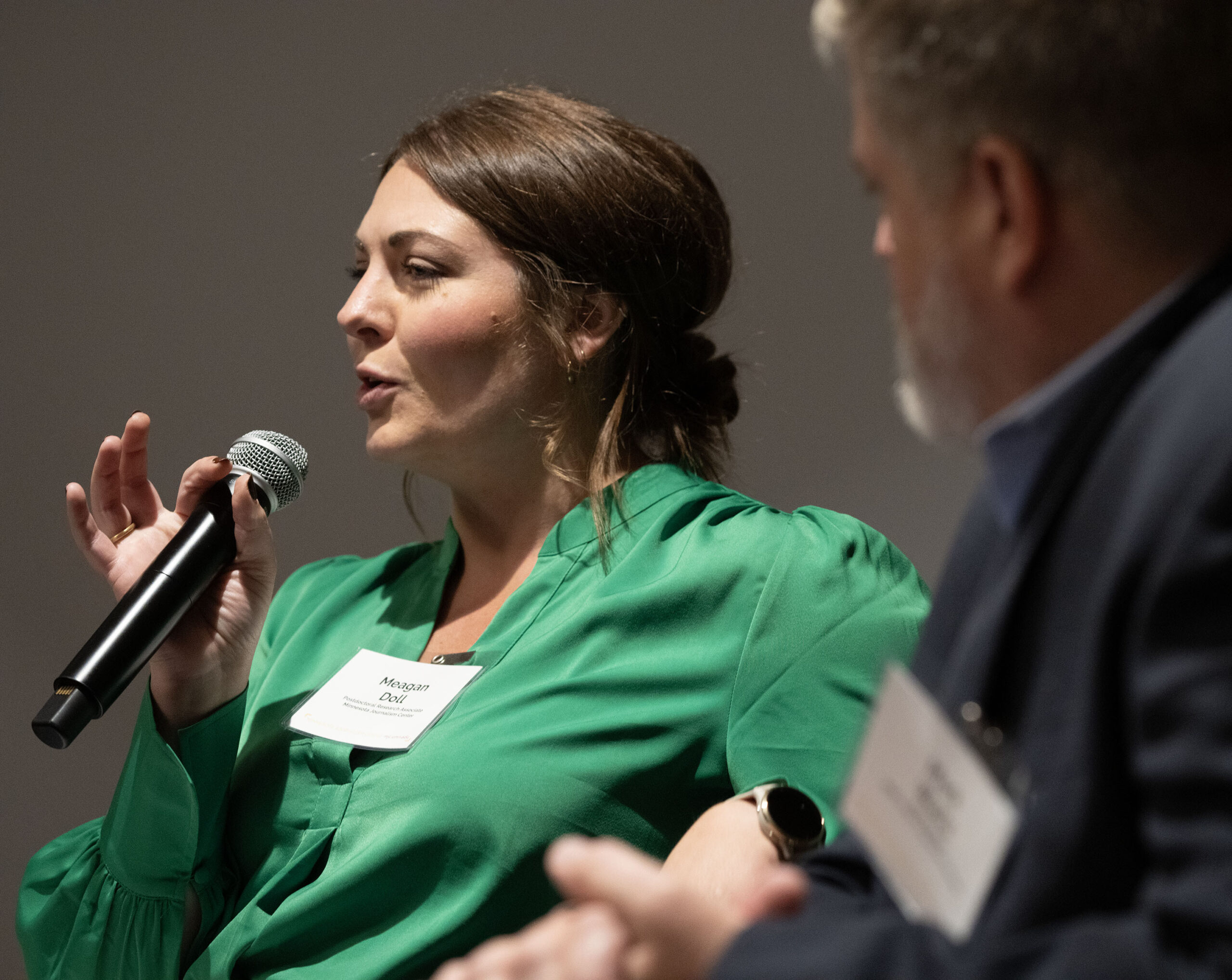
Doll speaking at a University of Minnesota symposium titled “The Future of State and Local Opinion Research” on Sept. 19, 2025.