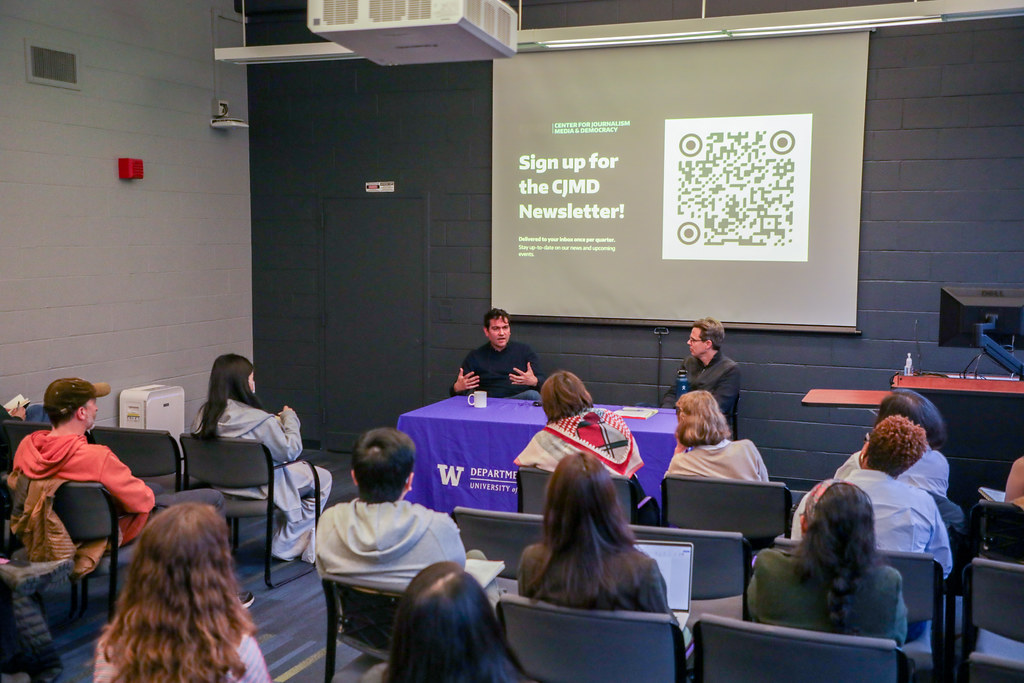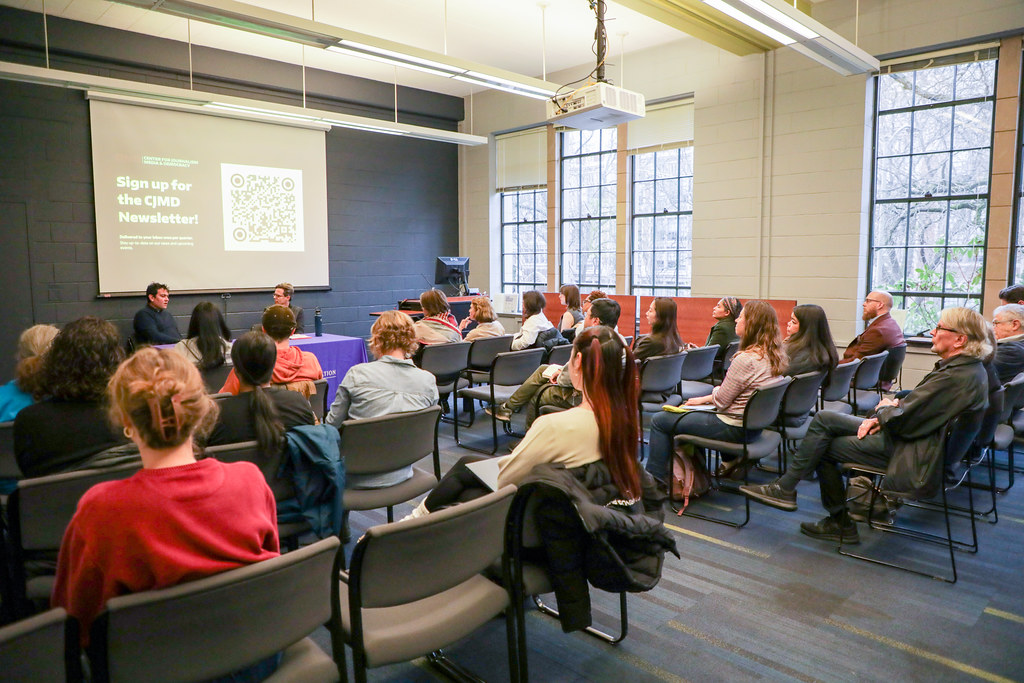
On Jan. 14 at the University of Washington, the Center for Journalism, Media, and Democracy (CJMD) hosted a discussion on political violence in the U.S. with The New Yorker staff writer Benjamin Wallace-Wells. Around 40 to 50 people filled the room, all students, faculty, staff, and community members interested in or studying journalism, communication, political science, and related fields.
Wallace-Wells spoke about his recent article “In the Line of Fire,” published in The New Yorker on Dec. 1, which examines the rise of political violence and threats against elected officials. Wallace-Wells said the idea for the article developed while he was reporting on politics and hearing from individuals working in political offices that threats had become routine. “It was in the air,” he said.

The article centers on Pennsylvania Gov. Josh Shapiro, whom Wallace-Wells said served as the spine of the story. Shapiro’s story is complex, with many sides: he is the democratic governor of Pennsylvania, one of the states with a high number of Jan. 6 defendants, and he has been active in suppressing pro-Palestinian protests on college campuses. On Passover last year, Shapiro and his family were targeted in an attack at their home. The perpetrator, Cody Balmer, set fire to part of the governor’s residence while Shapiro and his family were sleeping inside. The fire damaged a section of the home, but the family was able to evacuate safely.
Although the attacker had no documented affiliation with the pro-Palestine movement, Balmer confessed to the attack in a phone call to a 911 operator after the incident, saying, “Governor Josh Shapiro needs to know that Cody Balmer will not take part in his plans for what he wants to do to the Palestinian people.”
The following day, Shapiro held a press conference outside the residence, standing in front of the burned section of his home. Wallace-Wells used Shapiro’s experience to underscore how political violence operates in America today.
During the conversation at UW, Wallace-Wells described how political violence in the United States is changing in two main ways: scale and type. The scale can be measured by the growing number of threats directed at politicians. But change in type, which Wallace-Wells describes as the more interesting of the two, is less straightforward. Political attacks in the 20th century were often connected to movements, and the perpetrator’s path to radicalization could usually be traced—for example, Timothy McVeigh, who carried out the Oklahoma City bombing in 1995, was motivated by a staunch anti-government stance shaped by events like the 1993 Waco siege and the 1992 Ruby Ridge standoff. By contrast, political violence in the 21st century increasingly involves lone actors, with no co-conspirators or clear ideological journey. Balmer, like other recent attackers, shows no apparent story of radicalization.
Another major focus of the conversation had to do with the mimetic quality of these attacks — they copy the form of earlier incidents rather than coming from a clear ideological path. Motives are often tied to political slogans and sentiments instead of structured belief systems, as seen in the bullet casings from the Sept. 2025 ICE shooting in Dallas, which had “ANTI-ICE” written on them.
On the topic of motives, Wallace-Wells questioned the idea that political violence today is primarily driven by disenfranchised young men. While some extremist groups fit that narrative, many perpetrators of recent political violence do not. There is little consistency in this respect across cases, but one pattern discussed by Wallace-Wells and an audience member revealed how political violence today is similar to school shootings in that they are becoming a trend. In fact, Wallace-Wells named stories like this article in New York Times, “Like School Shootings, Political Violence Is Becoming Almost Routine”, as another influence for his article.
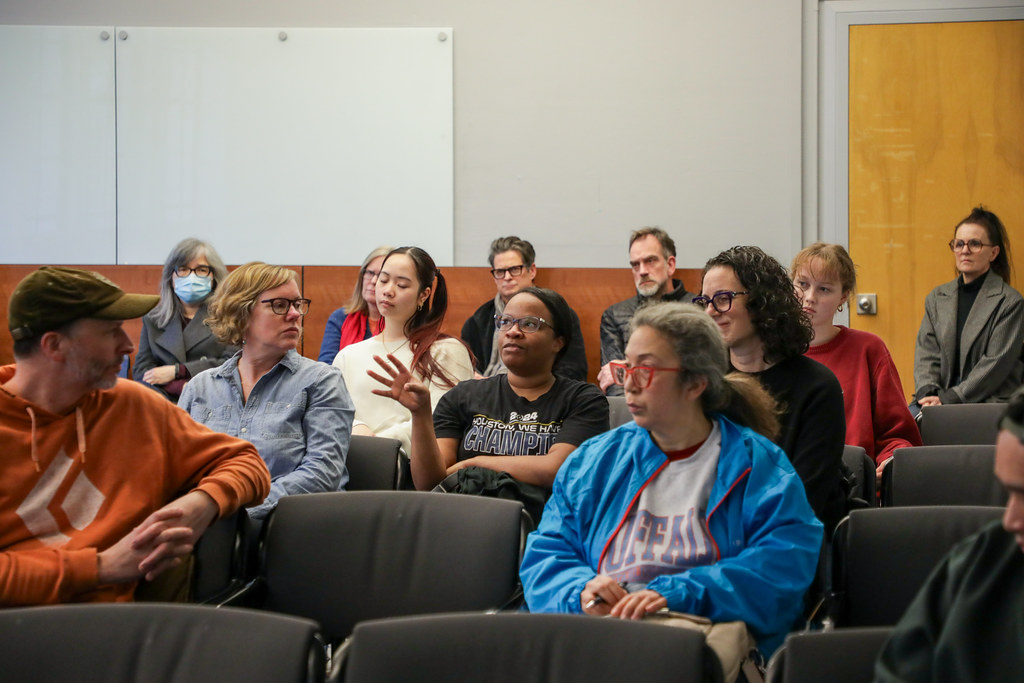
Wallace-Wells also brought up the increasingly blurry boundary between free speech and actual threats. For example, Wallace-Wells cited a common pattern identified by law enforcement in which a constituent repeatedly calls their representative about dissatisfaction with care at the Department of Veterans Affairs, only for the complaint to escalate into a direct threat. In more severe cases, threats implied surveillance, such as letters sent to a lawmaker’s home that included photos of their children, signaling proximity rather than stating violence outright.
Wallace-Wells noted in both the article and to the audience how political violence is already affecting public life. Some local officials have chosen not to run for office again. Others no longer advertise public events online, limiting public access and democratic participation. Similarly, political violence is shaping who enters politics. It was noted that the people who are more cautious are leaving public service, while others who are brave and less deterred by threats remain.
Wallace-Wells addressed responses to political violence, including calls to disengage from politics altogether, such as what journalist Derek Thompson has described as “touch-grass populism.” Wallace-Wells argued that this instinct—to look away from politics in hopes that threats and violence will subside—implicitly admits that liberalism does not have a ready solution to the problem. He then warned about the opposite risk: illiberal responses that move quickly toward blame and punishment. Politics often fails to distinguish between lone-actor violence and collective responsibility, creating fear that responses to political threats could lead to broader punishment, expanded state power and, ultimately, state violence.
The event concluded with a discussion of how political violence is affecting civic life. Wallace-Wells pushed back against the idea of “touch-grass populism,” the notion that we can avoid these problems by turning away from politics and ignoring what’s happening. Instead, he argued, these conversations need to happen so we can face the realities of political violence rather than hope it goes away on its own.