

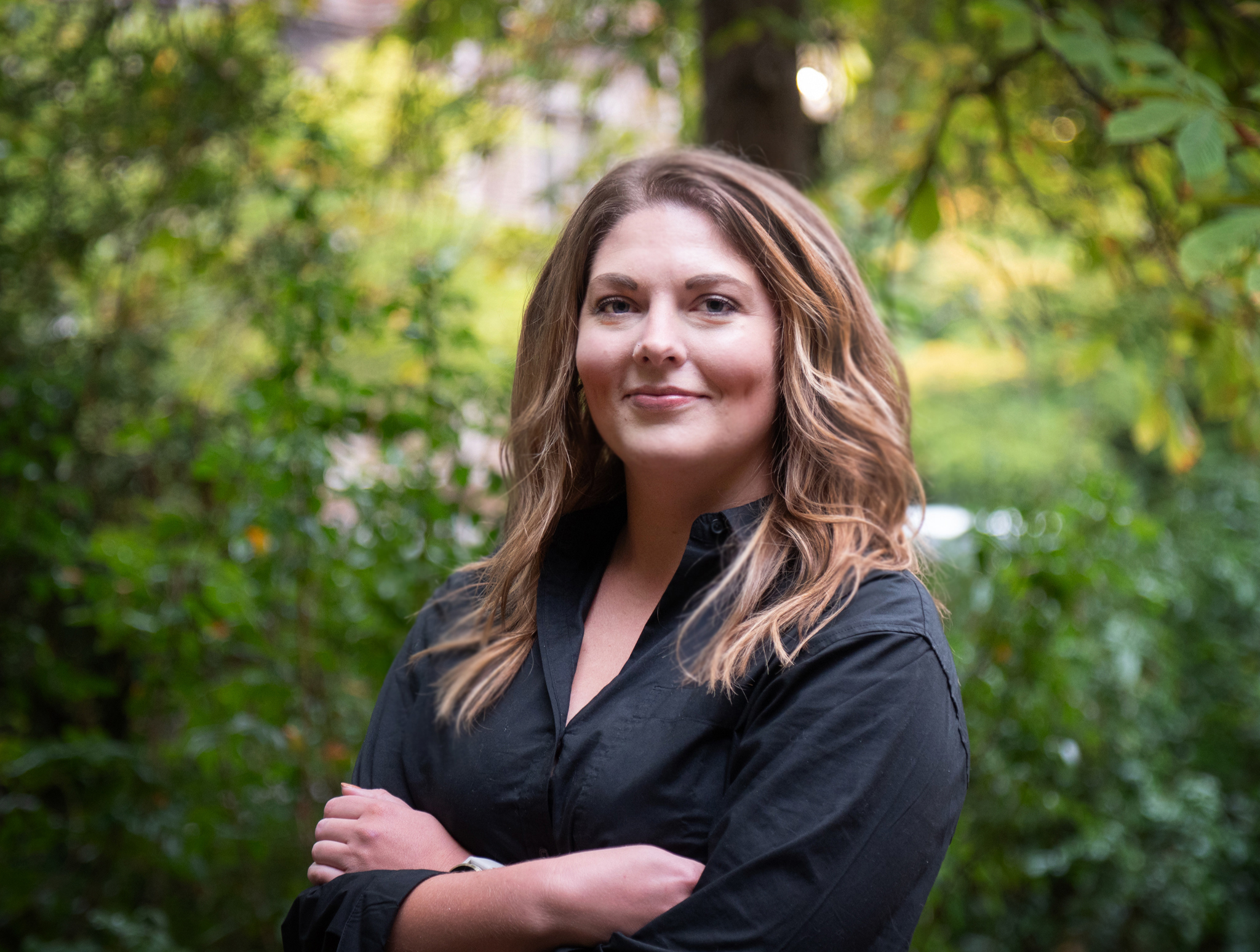
From UW graduate student to CU Boulder faculty member, Doll shares how her research, mentorship, and the CJMD community shaped her career trajectory.
After seven years of research, collaboration, and mentorship at the University of Washington (UW), Meagan Doll is moving on from the Center for Journalism, Media, and Democracy (CJMD), where she conducted much of her work as a master’s student, Ph.D. student, and postdoctoral fellow. This fall, Doll will begin a new role as an assistant professor of journalism at the University of Colorado Boulder, a move she describes as both personally and professionally meaningful.
“It sort of feels like a homecoming,” Doll said. She was born in Colorado Springs, and much of her family still lives in the area. Academically, she said CU Boulder had been a serious contender when she was applying to graduate school, before she ultimately chose UW.
Doll grew up in Wisconsin, about 40 miles north of Madison, and completed her undergraduate degree at the University of Wisconsin-Madison, where she earned a B.A. in journalism. While journalism was her primary focus, she was also drawn to the university’s interdisciplinary African studies program — one of the best in the country.
During her undergraduate years, she minored in African studies, completed a field study in Rwanda, and later reported from Uganda in 2015 as she finished her degree. Doll enjoyed her work but said that freelance foreign correspondence proved unsustainable for her.

Doll conducting fieldwork in 2023, standing outside a taxi park in Kampala, capital of Uganda.
“All journalism is difficult work, and foreign correspondence in freelancing was even harder,” Doll said, adding that after one summer she decided it was time to regroup. “I’m too type A, I guess, to be doing that.”
She returned to the University of Wisconsin and worked for the African Studies Program, eventually becoming an assistant director. Working closely with students, graduate students, and faculty drew her toward higher education administration. “I really liked working on a university campus,” she said. “It got to the point where I was like, ‘I could do admin forever.’ I really liked it, but to move up the admin ladder, at some point you do need a Ph.D.”
Doll chose UW for graduate school and ultimately earned both her M.A. and Ph.D in Communication. UW stood out to her because of the enthusiasm of the faculty and the opportunity to work closely with UW professor, researcher, and co-director of the Center for Journalism, Media, and Democracy (CJMD), Matthew Powers, whom she sought out early on. “He was the person that I wanted to work with, especially for my master’s thesis,” she said.
Through that connection, Doll became involved with the CJMD almost immediately. She described her introduction as being “kind of grandfathered into it,” beginning with weekly research meetings co-led by Powers and CJMD co-director, Adrienne Russell.
Those meetings were central to her professional development. “Providing feedback, receiving feedback, and integrating feedback from both graduate students and faculty was huge,” Doll said.
Much of Doll’s earlier scholarship focused on international contexts. Her master’s thesis, completed in 2021, examined peace journalism — journalism that reveals the structural and cultural roots of violence and their impact on people in a conflict arena — in East Africa. Her dissertation, completed in 2024, focused on audience trust in journalism in Uganda. That project drew on five weeks of fieldwork and a mixed-methods approach combining interviews and survey data.
One of the key insights from her dissertation, Doll said, was that trust in journalism cannot be separated from broader political conditions, especially in non-democratic environments.
“Evaluations of news and journalism can’t be understood outside of those political pressures,” she said. In Uganda, she found that audiences often held relatively positive views of journalism compared to other institutions, even while recognizing its limitations under restrictive press conditions.
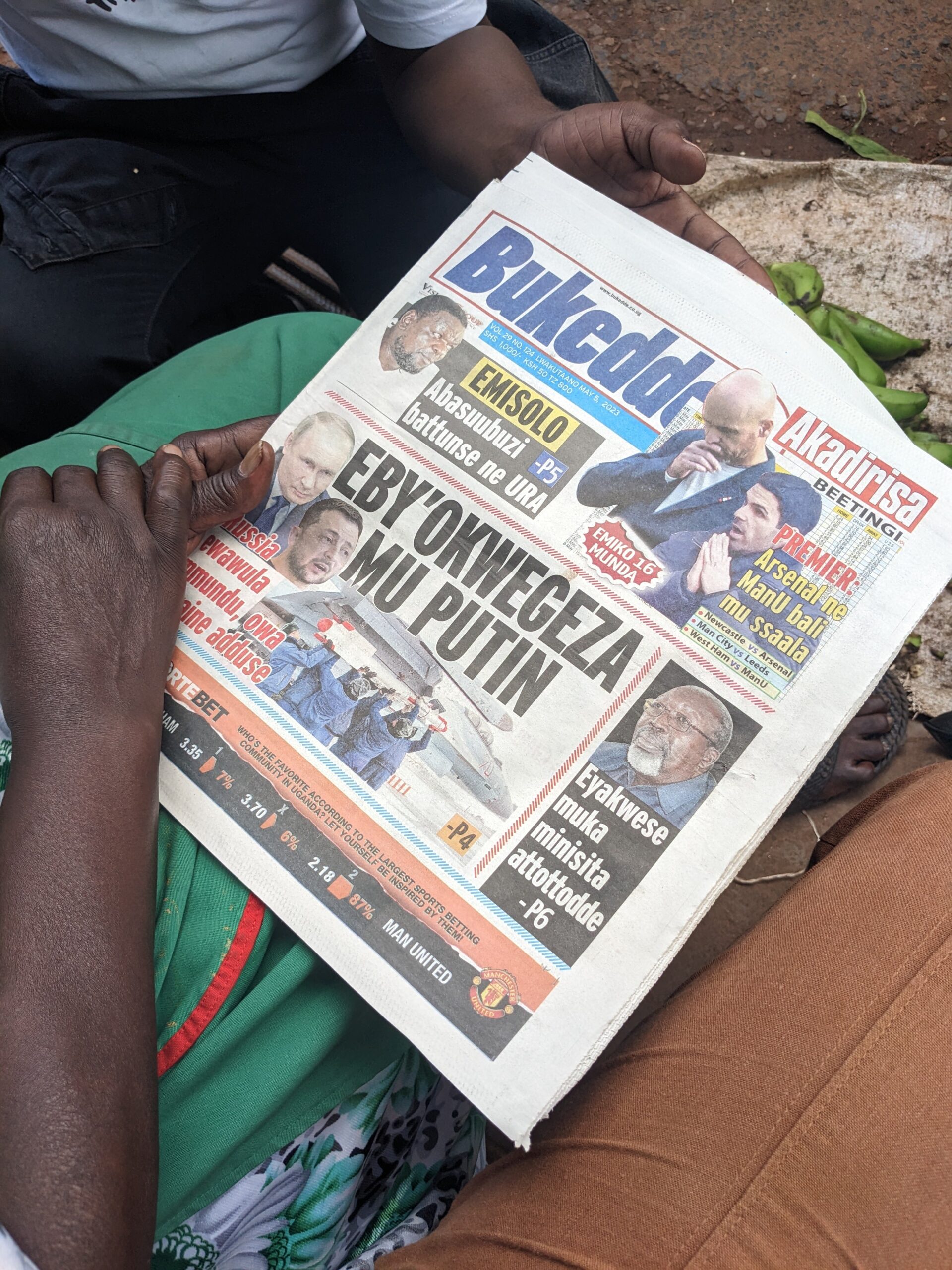
Photo of the front page of Bukedde, taken during an interview Doll conducted with a Kampala market vendor.
While obviously gratified by her dissertation, Doll described her first-ever publication — a meta-analysis of peace journalism content co-authored with Patricia Moy — as the crown jewel of her scholarship. The project began during her first year as a master’s student and ultimately became her master’s thesis. Doll said she is still proud of the work not only because she completed it so early on in her academic career, but because of its impact. The article has been cited extensively and continues to serve as a resource for scholars, helping shape the field’s collective understanding of peace journalism.
The CJMD was central to shaping Doll’s research trajectory. “Any success that’s come from my research since then is inherently touched by their ideas,” she said, referring to the feedback and collaboration she received through the center. She added that the experience helped her learn how to work on team-based, collaborative research projects, which she now considers essential to her career.
One of the most formative parts of her time at the CJMD was the opportunity to collaborate on long-term research projects. Alongside other students and faculty — particularly Powers and Moy, associate vice provost for academic and student affairs and senior fellow at the CJMD — Doll worked on a multi-year study of legislative coverage at the Washington State House. The project began with a large content analysis of coverage from the 2023 legislative session and expanded to include interviews with statehouse journalists, legislative staffers, and elected officials in Olympia. Take a look at her scholarly publications here:
- Missing a Beat? Exploring U.S. State Legislative Coverage Beyond the Politics Desk
- New life for statehouse reporting? The view from one American state
- Explaining the Feminization of Statehouse Reporting in One American State: A Field Analysis
Although U.S. state politics was not originally her main research focus, Doll said the project opened new intellectual and professional doors. “State politics is really important right now,” she said, noting that it remains underexplored in journalism research.
After completing her Ph.D. in 2024, Doll began a postdoctoral fellowship at the CJMD in June of that same year. Just one month later in July, she also became a postdoctoral research associate in the Hubbard School of Journalism and Mass Communication at the University of Minnesota. These dual postdoctoral roles have allowed her to focus heavily on research and begin adapting her dissertation into a book project. “The space to really work on that has been incredibly helpful,” Doll said.
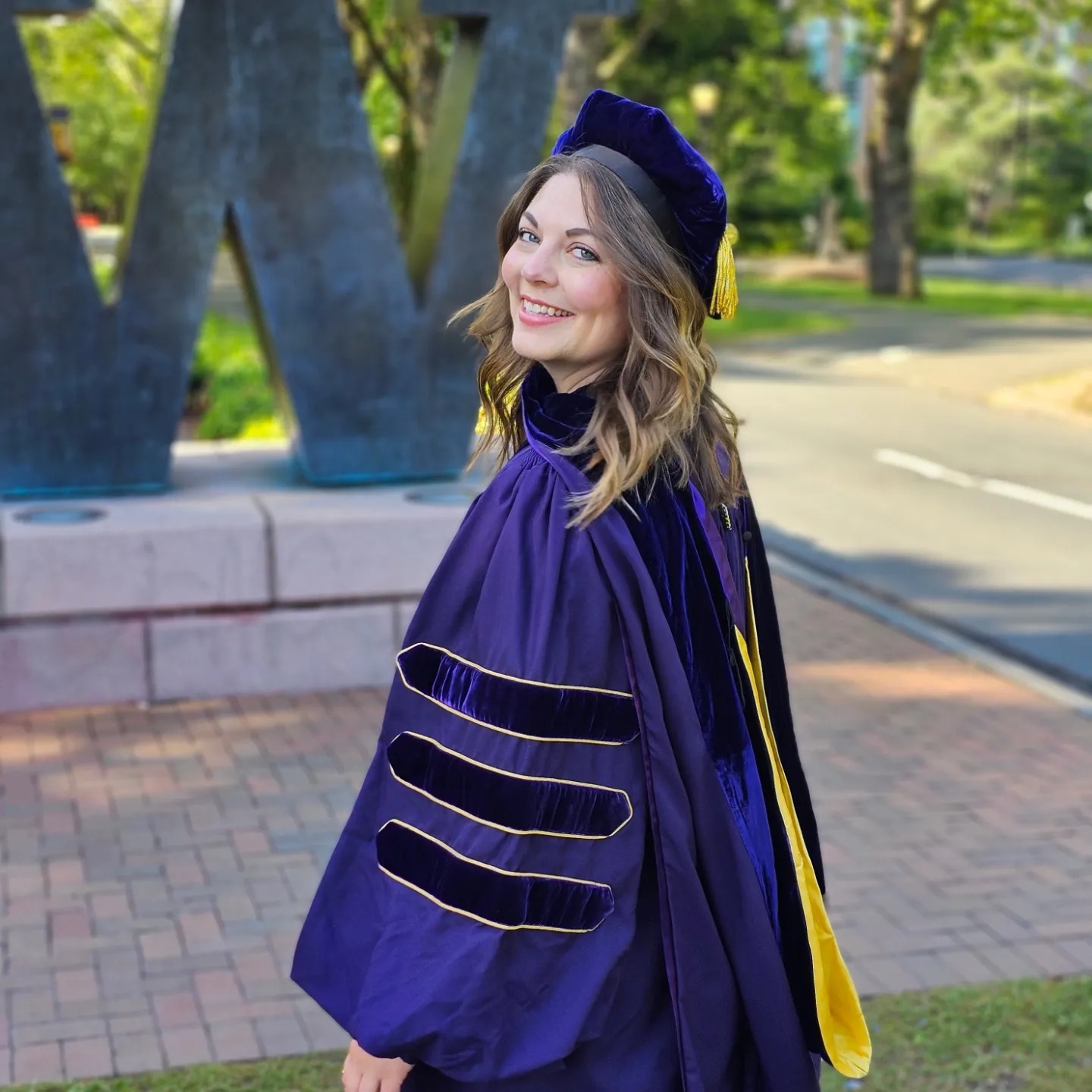
Doll in graduation regalia during 2024 UW commencement week.
As she prepares to leave UW and the CJMD and begin her new role in Colorado, Doll is excited to begin teaching students and to settle into a more permanent academic home. “It’ll be nice to have more interpersonal contact with students,” she said. “The gratification is more immediate than research, which can take years.”
When asked for advice for graduate students and those thinking about that path, Doll had this to say:
“Graduate school is hard. And there are so many times where you’ll want to turn inward and sometimes where you’ll have to, right? Like to focus on a specific paper or to meet a conference deadline or something. That’s normal and important at times.
“But I think pushing yourself to take an extra credit or to get involved in these research reading groups, they definitely take up a little bit of extra time. It’s extra pressure to read an extra article that week and give feedback to a colleague. But it’s really important — I think they mimic the real academic world and job landscape, even more in some ways than your coursework.
“That’s the pitch. You’re gonna feel like you don’t want to get involved in these extra responsibilities…extra research opportunities at times. But I think not only for being prepared for the job market, but also for keeping your interest and passion for research alive, it’s necessary to stay plugged into those spaces.
“’Cause graduate school is such an insular experience and can feel, at times, lonely. You spend so much time in your own head. Doing these collaborative group projects and going to the reading group, and going into campus even when you don’t want to, all of that is hard, but I think it makes your profession doable.”
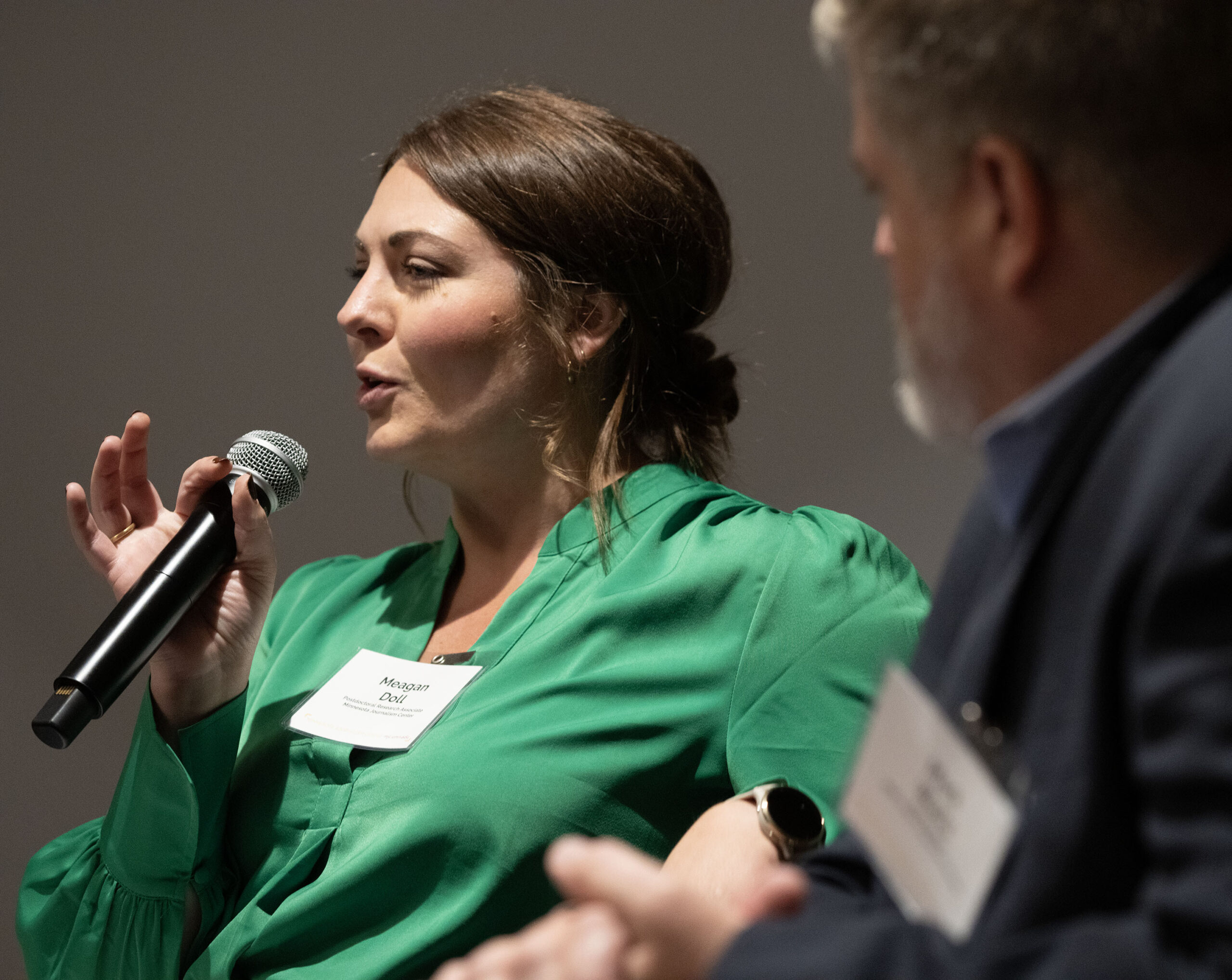
Doll speaking at a University of Minnesota symposium titled “The Future of State and Local Opinion Research” on Sept. 19, 2025.