

From misrepresentation to meaningful context, Iranian and Iranian-American journalists reflect on how solidarity can reshape reporting on conflict and crisis.
Journalism has long been guided by truth, accuracy, and public accountability. Yet moments of international crisis often reveal how difficult these ideals can be to uphold.
A recent panel discussion on solidarity, journalism, and Iran explored these tensions, asking what responsibility journalists have when covering conflict, how narratives about Iran have been shaped over time, and whether solidarity can exist within a profession that still holds objectivity as one of its central principles.
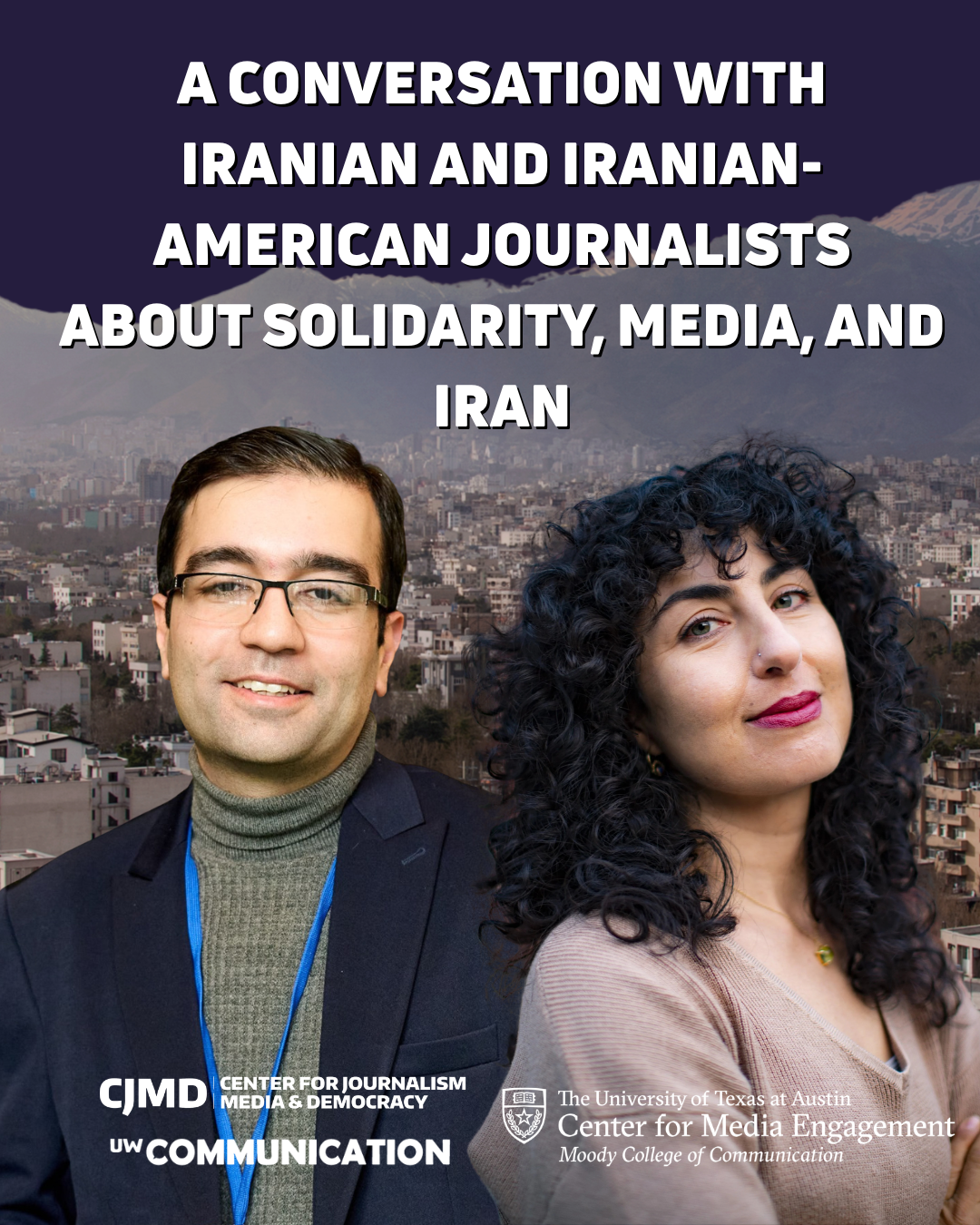
The conversation, hosted by the CJMD and University of Texas Austin’s Solidarity Journalism Initiative’s Dangerous Solidarity Working Group, was moderated by media studies researcher Sara Shaban, a fellow at the CJMD, affiliate instructor at the University of Washington, and author of Iranian Feminism and Transnational Ethics in Media Discourse. The panel featured two Iranian journalists and scholars: Neda Toloui-Semnani, an Emmy Award–winning journalist, author, and assistant teaching professor of journalism at Penn State University, and Kourosh Ziabari, a journalist and media studies researcher who contributes to Foreign Policy and New Lines Magazine. Together, they reflected on journalism’s role in shaping public understanding of Iran and the broader Middle East, and on how journalists might better center human experience in their reporting.
Shaban opened the conversation by acknowledging the conflicting narratives that often surround Iran in public discourse. Even within one city, she noted, people can witness dramatically different expressions of solidarity, with some demonstrations supporting international intervention and others protesting against it.
These contradictions reveal how complex the political and emotional landscape surrounding Iran has become. Toloui-Semnani responded by reflecting on her own evolution as a journalist — early in her career covering Washington politics, she began to feel uneasy about the way journalism often framed political power.
“I realized over time… that I was sort of participating in building a wall between the sort of the levers of power within this country…and the people who should feel empowered to be part of it,” she said. “The type of journalism I try to practice now…is meant to position the people who are sort of at the heart of all of these conflicting policies that we see.”
For Toloui-Semnani, solidarity journalism is not necessarily a separate genre of reporting but rather a commitment to telling stories in which people are not treated as bystanders to policy but as central figures within it.
Throughout the discussion, both panelists returned repeatedly to the importance of context in reporting on Iran. Much of the confusion people feel about Iran stems from the absence of historical and social context in news coverage.
“Context around Iran… is deeply lacking,” she said. Journalists often fail to show the everyday realities and external factors that shape people’s lives. One such example is the reporting of Iran’s water crisis. Toloui-Semnani says that understanding public frustration requires looking beyond politics alone.
“If you want to understand, for example, some Iranians’ anger, you have to understand there’s a water crisis,” she said. Ziabari echoed this concern, and said that decades of media narratives have contributed to misunderstanding and misrepresentation of the country.
“Had it not been for… a pattern of misrepresentation of Iran and Iranians in the global mainstream media, especially U.S. corporate media, maybe the direction of relations would have been different,” Ziabari said.
A comparison of coverage of Iran’s water crisis across American- and Iranian-based news organizations highlights the different storytelling approaches used to explain the issue. Iran International, in their Voices from Iran section, published an article in July 2025 titled “‘A big prison with no water or power’: fed up Iranians rue outages,” in which community members of cities such as Karaj are quoted. A New York Times article from March 2026 titled “War Brings New Water Crises to an Already-Parched Iran” only quotes experts who work for American universities.
While both articles attribute the water crisis to the same causes — “chronic mismanagement, flawed policy, and decades of unsustainable water use in agriculture and industry,” as Iran International puts it — only one includes the voices of those enduring the plight.
According to Ziabari, journalists must be willing to recognize their role in shaping the narratives that influence public opinion and policy decisions.
“[We] as journalists have been part of the problem,” he said. “Had it not been for our role as a part of the narrative and those who are cultivating this public discourse around global fault lines, many of these crises could have been prevented.”
The panel also explored the historical relationship between the United States and Iran, particularly the 1953 coup that removed Prime Minister Mohammad Mossadegh. Toloui-Semnani described the event as a turning point that continues to shape relations between the two countries.
The coup, she said, was “Great Britain’s idea… and it was carried out by the U.S.” through the CIA, which she described as “its first real attempt at asserting their influence abroad.”
Understanding this history is essential for understanding the present moment.
“Iran wasn’t just a passing part of American history,” she said. “It was integral to asserting [the United States’] power across the world.”
Ziabari expanded the discussion by highlighting Iran’s long history of civil resistance, from the 1999 student protests to the 2009 Green Movement and the 2022 Woman, Life, Freedom protests. These movements demonstrate that Iranian civil society has repeatedly challenged both domestic repression and foreign intervention.
“There’s no valid argument…that the Iranian people didn’t do enough,” he said. “Iran is a nation in which the political discourse has always been defined by dissent.”
Another key theme was the role of objectivity in journalism. Toloui-Semnani acknowledged that the concept historically served a purpose but argued that it can sometimes obscure deeper inequalities in power and experience.
“If being objective is going in and asking a bunch of questions…then one of my colleagues calls it shut up and listen journalism,” she said, meaning that listening carefully to communities should be a starting point for responsible reporting.
Ziabari approached the issue by emphasizing accountability. Objectivity, he said, is not inherently flawed, but it must include a willingness to challenge misinformation and dehumanizing rhetoric.
“Objectivity per se isn’t…something bad or something that is outdated,” he said. “But it also depends on how we define objectivity.”
For Ziabari, journalists must ensure that their work does not unintentionally reinforce narratives that strip people of their humanity. “We as journalists need to be the voice of our principles,” he said. All reporters should challenge false claims and defend the dignity of those whose stories they tell.
While the conversation focused on the current crisis, the panelists emphasized that journalists should not define Iran solely through conflict or crisis. Ziabari urged journalists to tell broader stories about culture, creativity, and everyday life.
“The food that the people of Iran produce and consume, the art that they produce…these are still missing from our perspectives and narrative,” he said. Expanding coverage to include these dimensions would create a more complete and human understanding of the country.
Toloui-Semnani implored journalists to ask difficult questions and confront contradictions in political discourse. “I’m not an advocacy journalist,” she said. “But I advocate against silence.”
For both speakers, solidarity in journalism ultimately means recognizing the humanity at the center of every story and refusing to allow complex societies to be reduced to simplified narratives.