

UW Assistant Professor and CJMD fellow Jisoo Kim explores how media narratives shape polarization, public trust, and perceptions of science.
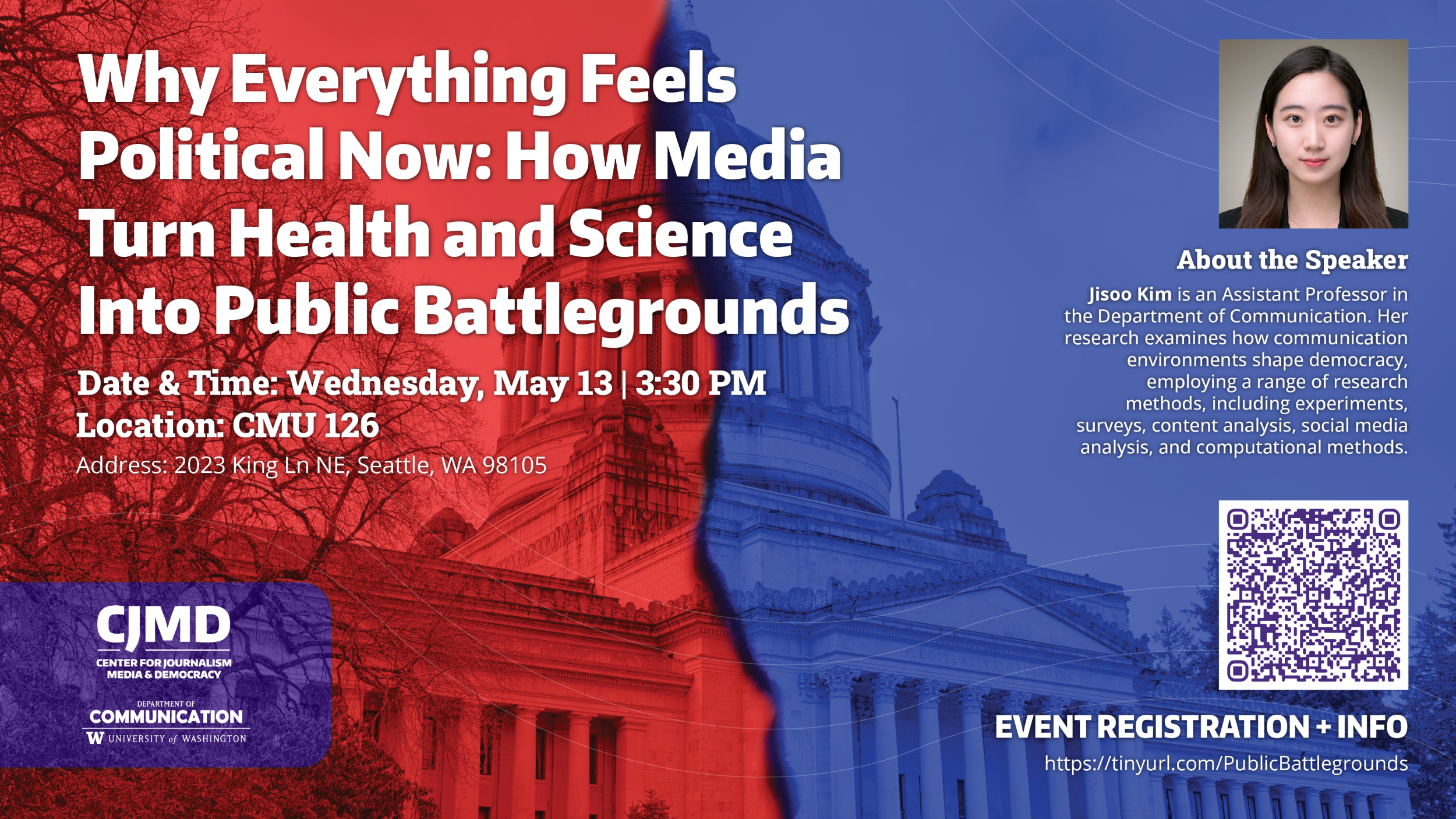
At a time when public debates around science and health increasingly feel inseparable from politics, University of Washington Assistant Professor and CJMD fellow Jisoo Kim urged audiences during her May 13 talk hosted by the CJMD to reconsider what “politicization” actually means and how it shapes public understanding.
Hosted by the Center for Journalism, Media and Democracy (CJMD), Kim’s talk, “Why Everything Feels Political Now,” brought together students, faculty, and community members for a discussion on how media transform scientific and health issues into partisan conflict. Drawing on research surrounding COVID-19 vaccines and climate change, Kim examined the communication patterns that deepen political division and influence trust in science.
Kim opened by reflecting on how politicization has expanded far beyond electoral politics and now permeates everyday life. Debates surrounding vaccines, environmental policy, and public health funding, she argued, increasingly shift attention away from shared concerns and toward partisan identity.
“With all of those cases, we can see that the word politicization seems now everywhere,” Kim said. “But what do we really mean by politicization? What constitutes this concept? And why and how strongly can it influence our attitudes and behaviors?”
To answer that question, Kim and her research team reviewed existing scholarship on politicization and identified four recurring dimensions: controversy, uncertainty, political discussion, and blame. While previous research has often defined politicization by tracking how frequently politicians or political actors appear in media coverage of issues like climate change and COVID-19 vaccines, Kim argued that this approach overlooks other communicative dimensions that can also shape political division and public perception.
Instead, her research suggests that conflict itself — even without explicit political references — can trigger political thinking and increase perceptions of division.
Using an experimental study on COVID-19 vaccine messaging, Kim and her colleagues analyzed how different communication cues influenced Democrats’, Republicans’, and Independents’ perceptions of politicization. Participants viewed social media-style posts modeled after real-world vaccine discourse, with messages emphasizing varying levels of controversy, uncertainty, political references, and blame.
The findings revealed clear partisan differences in how participants responded to different kinds of politicizing cues. Among Republicans, controversy cues, rather than direct references to politicians, were the most influential in shaping perceptions of polarization. Kim explained that even words emphasizing conflict or disagreement, such as “anti-vaxxers versus pro-vaxxers,” could lead participants to associate vaccines with politics and political actors.
“Simple words like ‘conflicts,’ ‘disagreements,’ ‘foils,’ ‘anti-vaxxers versus pro-vaxxers,’” Kim said, “actually activated Republicans’ thoughts about politicians and political figures.”
Among Democrats, uncertainty cues played an important role in shaping responses to the vaccine messages. Messages emphasizing scientific uncertainty increased perceptions that COVID-19 vaccines were unreliable, which in turn negatively affected vaccine attitudes. At the same time, however, those same uncertainty cues also reduced perceived polarization and decreased perceptions of political discussion and blame. Kim suggested this pattern may reflect differences in how liberal- and conservative-leaning individuals respond to uncertainty and conflict.
“Democrats who became uncertain at the perceptual level,” Kim explained, “may not really get involved in the partisan discussion or partisan orientation.” Instead, she suggested they may “just step aside from this uncertain issue and try to observe.”
The implications, she argued, are especially important in the context of social media platforms, where short-form communication often leaves little room for nuanced scientific discussion.
“When we consider the platform characteristics of social media,” Kim said, “we may not really want to highlight the uncertain nature of science…while we promote some more effective health measures.”
The discussion concluded with questions about how ordinary people define politicization in their everyday lives. Kim acknowledged that while scholars often study politicization through specific communication cues, public understandings of the term are varied.
Still, the talk underscored a central concern driving Kim’s work: as media increasingly frame scientific issues through conflict and partisan division, politicization itself becomes not just a political phenomenon, but a communicative one that shapes how people understand reality, expertise, and each other.