

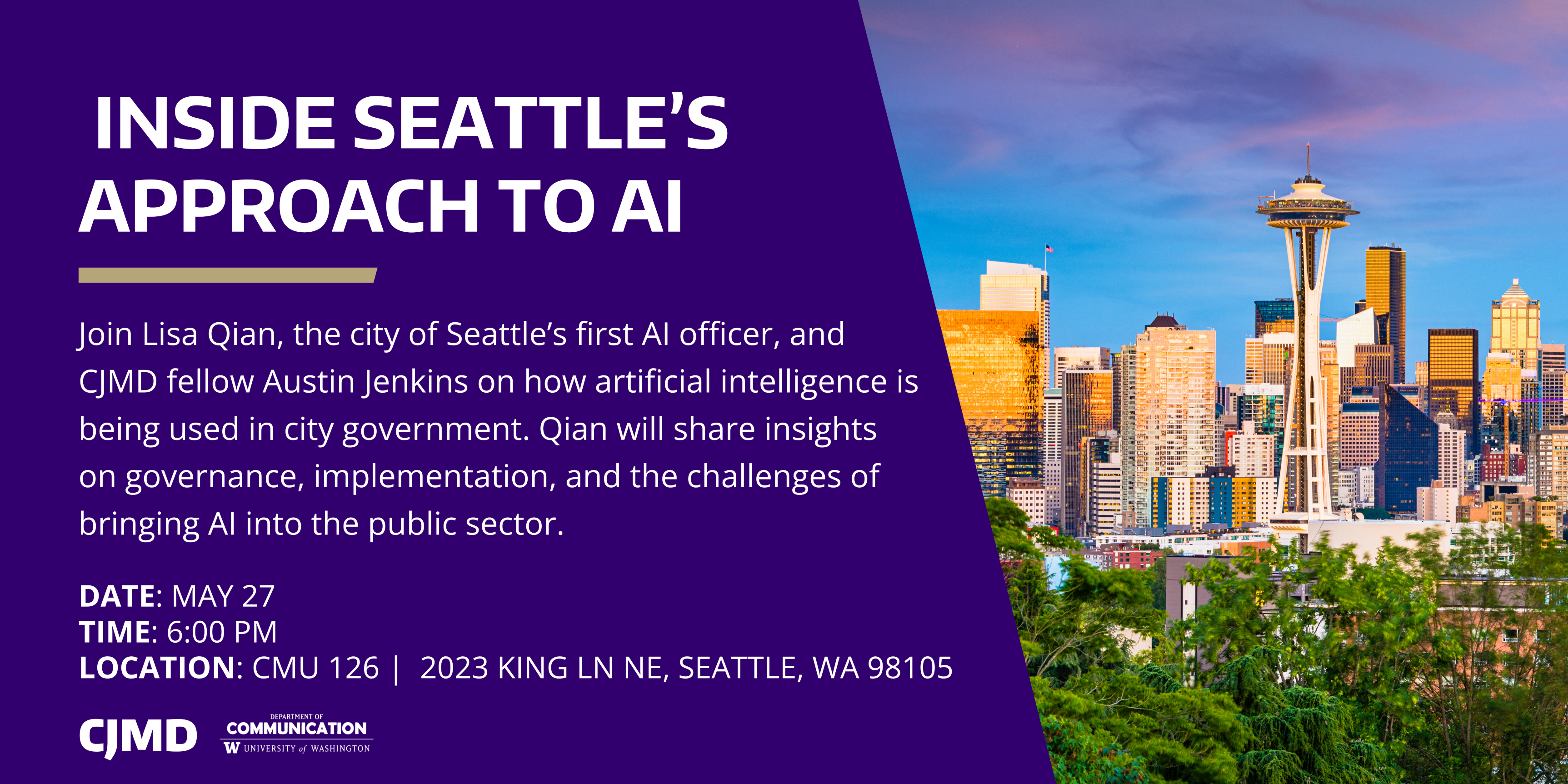
On May 27, the Center for Journalism, Media and Democracy (CJMD) hosted a conversation with Lisa Qian, Seattle’s first artificial intelligence officer, and Sarah Carrier, privacy program manager with the City of Seattle’s Data Privacy, Responsible AI, & Compliance team. Moderated by CJMD fellow Austin Jenkins, the discussion explored how the city is approaching the responsible use of AI across public services and internal operations.
Carrier opened by explaining that Seattle’s approach to responsible AI grew out of its existing privacy and compliance work. The city holds large amounts of resident data and must consider how new technologies could affect the people it serves.
“We need to understand the impacts, and part of that is risk,” Carrier said. “How are we bringing on these tools? How are we thinking about the impacts? How are we addressing risk? How are we communicating in a transparent way with the residents that we serve?”
Carrier said the city began developing its responsible AI program after the arrival of ChatGPT in 2022. Shortly after, the city brought together experts from the University of Washington, the Allen Institute for AI, and Seattle’s Community Technology Advisory Board to help shape a policy framework.
The result of this collaboration was one of the nation’s first generative AI policies.
“It’s not just the technology,” Carrier said. “It’s the use case. It’s the deployment context. It’s all of these things holistically, thinking about how those things can impact residents that we serve.”
AI and the permitting process
Qian described permitting as one area where AI could improve city services. Permit applications often involve multiple departments and can be delayed because information is missing or residents do not know where to submit materials.
One proposed tool could flag missing information before an application reaches a reviewer. Another pilot involves a chatbot that could help residents identify which permits they need by drawing from policies spread across city websites.
“You can ask it a question, and it can tell you, ‘Hey, this is what you’re trying to do. These are the permits that you need,’” Qian said.
The permitting example also raised questions about public engagement. Qian said resident-facing tools should be tested through pilots, focus groups, and feedback sessions before broader deployment. Carrier pointed to partnerships with trusted institutions, including the Seattle Public Library, as one way to build public understanding of AI.
Beyond efficiency
Carrier and Qian emphasized that efficiency is only one part of the city’s review process. Environmental impact, racial equity, labor concerns, and long-term reliability also matter.
Qian said the city is not looking to replace workers with AI.
“Everything that we’ve done, it’s with the intention of augmenting people’s skills and improving what they already do, not to replace anybody,” Qian said.
Audience members also raised concerns about vendor dependence, software changes, and the risk of relying on startups that may not exist in the long term. Carrier said the city looks for configurable products and negotiates contract terms around substantive changes to AI systems. Qian added that limited pilots can help the city test tools before committing to a vendor.
Coordinating the city’s approach
Seattle appointed Qian as its first AI officer to help bring greater coordination to a rapidly evolving area of work. During the discussion, she described her mandate as spanning three broad areas: governance, implementation strategy and architecture, and workforce upskilling.
Carrier said the role can help connect work already happening across city departments and ensure that decisions are not made in isolation.
“The most effective way to govern something is to have a lot of people, a lot of voices at the table with diverse perspectives and unique experiences and lenses,” Carrier said.
For Qian, the value of technical expertise lies partly in navigating between two extremes: the argument that cities should adopt AI everywhere as quickly as possible, and the fear that public agencies should reject the technology altogether.
“The reality is probably somewhere in between,” Qian said.